THE ULTIMATE VW/AUDI TURBO GUIDE
From stock to full race — everything you need to know about turbocharging your VW or Audi. Twelve chapters of turbo theory, platform-specific build guides, and 40 years of real-world experience.
HOW TURBOCHARGERS WORK
A turbocharger converts exhaust energy that would otherwise be wasted into compressed intake air — free horsepower from gas you've already burned. Understanding how each component works is the foundation for every upgrade decision you'll make.
COLLAPSE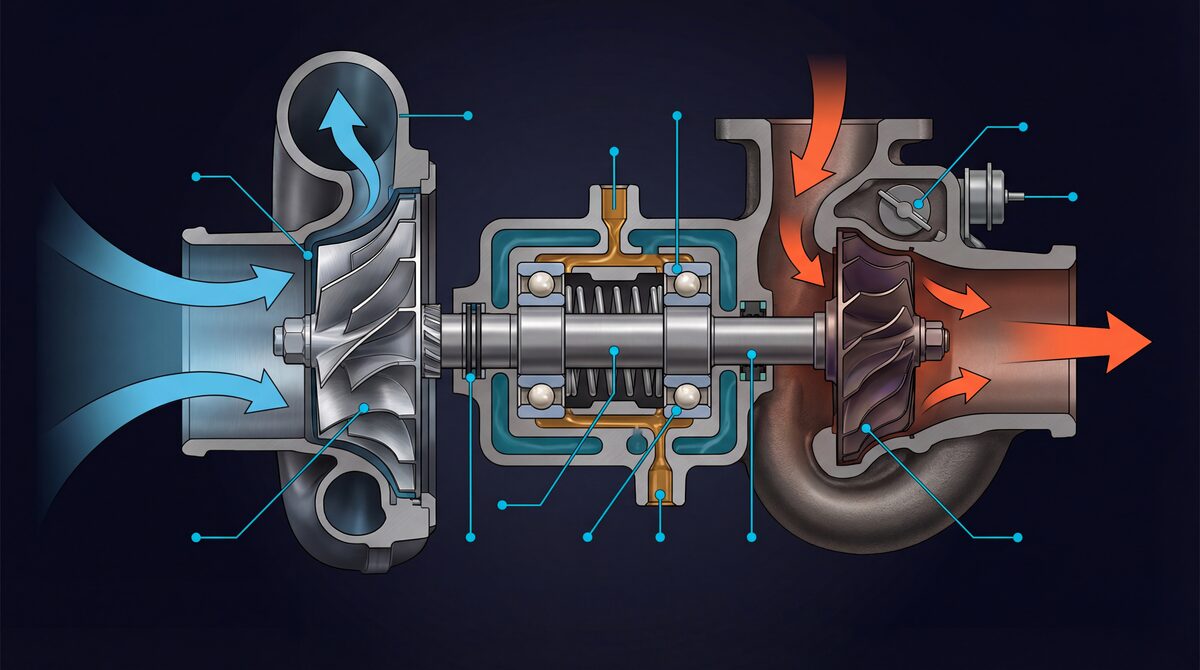
THE 1/3 RULE
Every internal combustion engine wastes most of the energy it produces. Of all the energy released during combustion, roughly one third goes to the crankshaft as useful mechanical work, one third is absorbed by the cooling system as heat, and one third exits through the exhaust as heat and kinetic energy. A naturally aspirated engine just dumps that exhaust energy out the tailpipe. A turbocharged engine puts it to work.
This concept — called the "1/3 rule" in Corky Bell's classic book Maximum Boost — is the fundamental principle behind turbocharging. The turbocharger sits in the exhaust stream and uses that otherwise-wasted energy to spin a turbine wheel. That turbine is connected via a shaft to a compressor wheel on the other side, which compresses incoming air and forces it into the engine. More air means more fuel can be burned per cycle, which means more power from the same displacement.
This is why turbocharging is so efficient compared to other forms of forced induction. A supercharger uses a belt driven off the crankshaft — it consumes engine power to make boost. A turbocharger uses energy that was leaving the system anyway. It's not truly "free" horsepower — there is a small exhaust backpressure penalty — but it's remarkably close.
THE COMPRESSOR SIDE
The compressor side of a turbocharger is responsible for drawing in ambient air and compressing it before sending it to the engine. It consists of four key components:
Compressor Wheel
The compressor wheel is a precision-machined impeller made from aluminum (typically 2618 alloy in high-performance applications, or cast A356 in OEM turbos). It spins at speeds up to 150,000+ RPM in small-frame turbos, though most VW/Audi applications operate between 80,000 and 130,000 RPM. The wheel has two critical dimensions:
- Inducer diameter: The smaller inlet side where air enters the wheel. This dimension primarily determines the turbo's airflow range. A larger inducer = more potential airflow = more top-end power, but typically slower spool.
- Exducer diameter: The larger outlet side where compressed air exits radially into the diffuser. The ratio between inducer and exducer (called the "trim") affects the wheel's efficiency across its operating range.
Modern compressor wheels use extended-tip designs with splitter blades — smaller blades between the main blades that improve efficiency at the inlet where flow transitions from axial to radial. Precision Turbo's Next Gen series, for example, uses a 7x7 CEA design: 7 main blades plus 7 splitter blades, all machined from forged 2618 aluminum billet. These designs flow approximately 10% more air than previous-generation cast wheels of the same dimensions.
Compressor Cover (Volute)
The compressor cover is the housing that surrounds the compressor wheel and collects the compressed air as it exits radially. The cover shape acts as a diffuser — converting the high-velocity air leaving the wheel into high-pressure, lower-velocity air that can be piped to the intercooler. Compressor covers come in different sizes that affect packaging and flow:
- SCP (Standard Cast Ported): Compact design with a 2.5" outlet. Better for tight engine bays like the MK4 or B5. Most VW turbo builds use SCP covers.
- HP (High Performance): Larger design with a 3.0" outlet. Maximum flow for dedicated race builds, but may require custom charge piping in transverse VW engine bays.
The compressor cover also includes a ported shroud — a recirculation slot near the inducer that recycles some air back to the inlet during surge conditions. This anti-surge feature widens the compressor's usable operating range, allowing it to maintain stable airflow at higher pressure ratios. It's not a free lunch — ported shrouds slightly reduce peak efficiency — but the gain in usable range is worth it on any street-driven car.
THE TURBINE SIDE
The turbine (or "hot side") is where exhaust energy is converted into rotational force. The exhaust gas enters the turbine housing at high temperature and velocity, flows through the volute to accelerate and direct it onto the turbine wheel blades, spins the wheel, and then exits through the center of the wheel and out the downpipe.
Turbine Wheel
Turbine wheels operate in an extreme environment — exhaust gas temperatures of 1,600-1,800°F on gasoline engines, spinning at the same 80,000-130,000+ RPM as the compressor (they're on the same shaft). This is why turbine wheels are made from Inconel 713C or Mar-M 247, nickel-based superalloys that maintain strength at extreme temperatures. Unlike compressor wheels, turbine wheels are almost always investment cast, not machined from billet — the alloys are too hard and the shapes too complex for economical machining.
The turbine wheel has two important dimensions that mirror the compressor side:
- Turbine inducer: The outer diameter where exhaust gas enters the wheel.
- Turbine exducer: The inner diameter where spent exhaust exits toward the downpipe. Precision Turbo names their models after these dimensions — a "6670" has a 66mm compressor inducer and 70mm turbine exducer.
Turbine Housing and A/R Ratio
The turbine housing is arguably the most important variable in turbo system tuning. It determines how exhaust energy is presented to the turbine wheel — how fast the gas moves, at what angle it hits the blades, and how much backpressure builds upstream.
The critical specification is the A/R ratio (area over radius). This describes the cross-sectional area of the housing's volute at a given point, divided by the distance from the center of that area to the center of the turbine wheel. A smaller A/R accelerates exhaust gas more aggressively — the turbine spools faster, but creates more backpressure at high RPM. A larger A/R lets the turbo breathe more freely at high RPM but delays spool-up.
For VW/Audi applications, here's how A/R selection typically breaks down:
| A/R Range | Spool Character | Best For | VW Application |
|---|---|---|---|
| 0.48 - 0.58 | Very fast spool, high backpressure | Small displacement, low-RPM torque | 1.8T daily drivers, autocross |
| 0.63 - 0.82 | Mid-range — the VW sweet spot | Street performance, weekend track | 1.8T performance builds, VR6T street |
| 0.96 - 1.15 | Slower spool, excellent top-end flow | Race builds, high-RPM power | VR6T race, big turbo 1.8T track builds |
| 1.32+ | Slow spool, minimal backpressure | Dedicated drag, large displacement | Built VR6 drag cars, 4-cylinder strokers |
THE CENTER SECTION: BEARINGS AND OIL
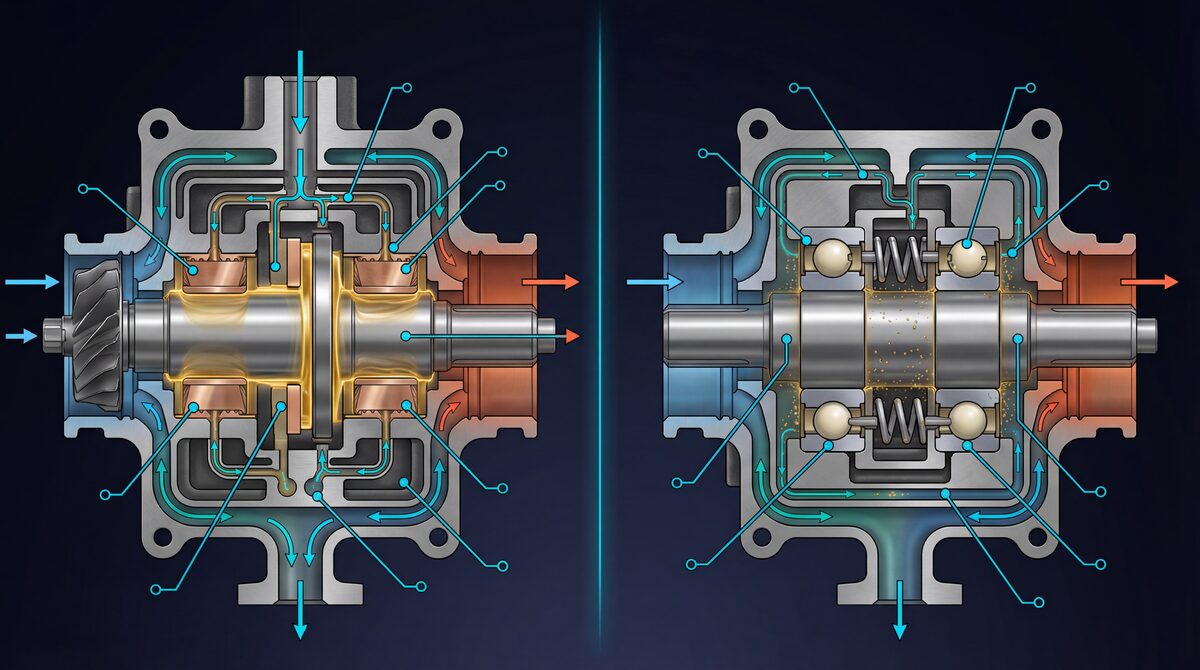
The center housing rotating assembly (CHRA) connects the compressor and turbine wheels on a single shaft and manages the lubrication and cooling that keeps everything alive at 100,000+ RPM. There are two bearing technologies used in modern turbochargers:
Journal Bearings
Journal bearings (also called sleeve or plain bearings) support the shaft on a thin film of pressurized oil — the shaft literally floats on oil. There are typically two journal bearing surfaces (compressor-side and turbine-side) plus a thrust bearing that handles axial loads. This design requires high oil flow (1.5+ GPM) and consistent oil pressure to maintain the hydrodynamic film. If oil flow drops — even briefly — metal-to-metal contact occurs and the bearings fail.
Journal bearing turbos are less expensive to manufacture and rebuild. They're still used in many OEM applications and are perfectly adequate for most builds. The primary disadvantage is transient response — it takes slightly longer for the shaft to accelerate because the oil film creates viscous drag.
Ball Bearings
Dual ceramic ball bearing (DCBB) turbos use two angular-contact ball bearings — one at each end of the shaft — preloaded with a spring. The bearings use ceramic (silicon nitride) balls running in steel races, which offers several advantages:
- Faster spool: Ball bearings have dramatically less friction than journal bearings. Real-world testing shows 10-15% faster transient response (time to reach target boost from a given RPM). On a small-displacement engine like the 1.8T, this translates to noticeably quicker boost onset.
- Lower oil requirements: Ball bearings don't need the same volume of oil to maintain a hydrodynamic film. They're more tolerant of brief oil pressure drops during hard cornering or aggressive driving.
- Better high-temperature survival: Ceramic balls resist heat better than oil films. This matters at shutdown — the turbo continues spinning after the engine stops and oil pressure drops. Ceramic bearings survive the coast-down period better than journal bearings, which is why water cooling is critical for journal bearing turbos.
Every turbo in the Precision Turbo Next Gen lineup uses their Air-Cooled Dual Ceramic Ball-Bearing (ACBB) design. For VW applications where the turbo lives in a tight engine bay with limited airflow, ball bearings are a meaningful upgrade over journal bearing equivalents.
Water-Cooled vs Air-Cooled Center Housing
Heat is the enemy of turbo bearings. The turbine side operates at 1,600°F+, and that heat conducts through the shaft and housing toward the bearings. In a water-cooled center housing, engine coolant circulates through passages in the CHRA, carrying heat away from the bearing surfaces. This is especially critical at shutdown — after you turn off the engine, coolant continues to thermosiphon through the housing (hot fluid rises, cool fluid descends), preventing the residual heat from coking the oil on the bearing surfaces.
Oil coking is the primary cause of premature turbo death on VW/Audi cars. When oil sits on a hot bearing surface with no flow, it carbonizes into hard deposits that score bearing surfaces and block oil passages. This is why you should always let a turbocharged car idle for 30-60 seconds after hard driving before shutting it off — and why VW/Audi uses water-cooled turbo center housings from the factory on every turbocharged model.
WASTEGATES AND BOOST CONTROL
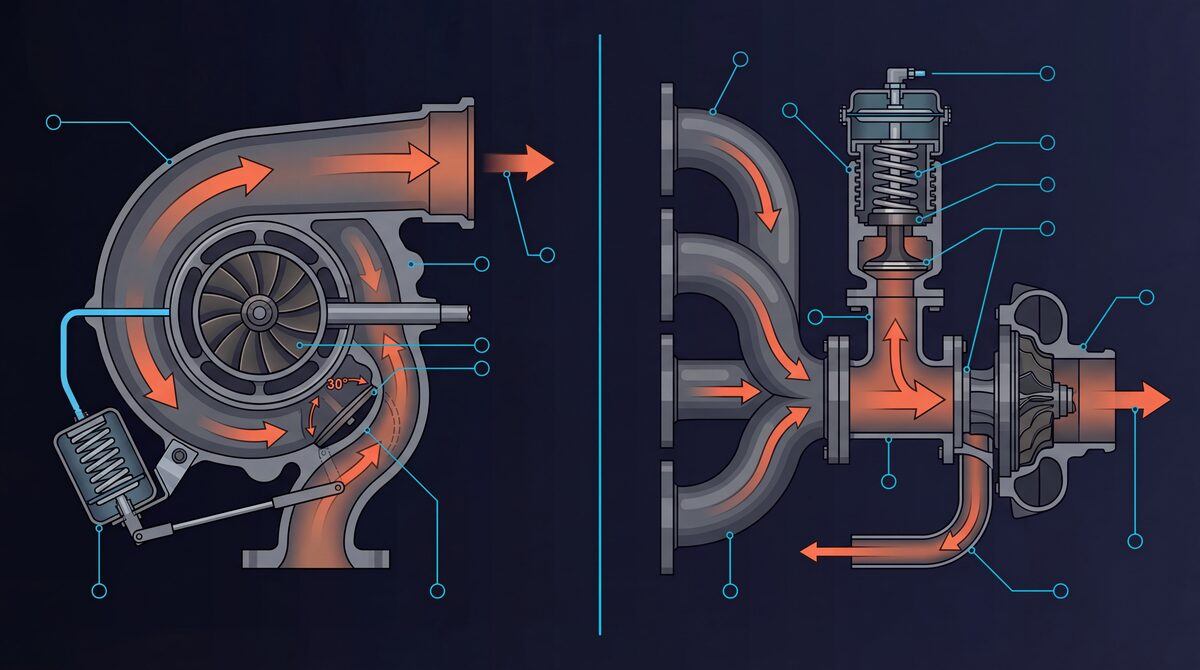
A wastegate is a controlled exhaust bypass that limits turbo speed and, therefore, boost pressure. Without a wastegate, boost would continue rising until something breaks — the turbo overspeeds, the compressor surges, or the engine detonates. Every turbo system needs a way to regulate peak boost.
Internal Wastegate
Most OEM and many aftermarket turbochargers have an internal wastegate — a flap valve built into the turbine housing that opens a bypass passage. When boost pressure reaches the target, the wastegate actuator (a spring-loaded diaphragm connected to the flap via a mechanical arm) opens the flap, allowing exhaust gas to bypass the turbine wheel and go directly to the downpipe. This reduces the energy hitting the turbine, capping boost at the desired level.
Internal wastegates are compact and simple — no extra plumbing needed. Their limitation is flow capacity. The bypass port is relatively small, which means on high-power builds (roughly 400+ WHP on a 1.8T), the internal gate can't flow enough exhaust to hold target boost, resulting in boost creep — uncontrolled boost rise at high RPM.
External Wastegate
An external wastegate is a separate valve body mounted on the exhaust manifold upstream of the turbo. It diverts exhaust gas before it reaches the turbo, with a dump tube routing the bypassed gas back into the exhaust downstream (for street) or venting to atmosphere (for race). External gates use a larger poppet valve and interchangeable spring stacks, giving you precise control over opening pressure and response characteristics.
External wastegates are standard on any VW/Audi build making serious power — typically anything above 450-500 WHP. Common sizes are 38mm for smaller builds and 44mm+ for builds exceeding 600 WHP. TiAL and Precision Turbo make the most popular external gates in the VW community. The exhaust manifold must have a dedicated wastegate port, which is standard on aftermarket turbo manifolds from brands like ATP, CTS, and 034 Motorsport.
Electronic Boost Control
VW/Audi uses electronic boost control on all factory turbocharged models. The N75 solenoid (found on 1.8T and early EA888) or electronic wastegate actuator (EA888 Gen3+) allows the ECU to precisely modulate boost pressure across the entire RPM range — not just set a single peak value. This enables:
- Boost-by-gear: Lower boost in first gear (traction management), full boost in higher gears
- Overboost: Temporary boost spike above the sustained target for acceleration (VW's 10-second overboost on the Golf GTI)
- Altitude compensation: Adjusting boost targets to maintain consistent power at different elevations
- Closed-loop control: Using the MAP sensor to monitor actual boost and correct in real-time, compensating for temperature changes, aging components, and mechanical wear
Aftermarket ECU tunes (from Unitronic, APR, IE, EQT, etc.) reprogram these boost targets and the control strategy to run higher boost safely. External boost controllers (manual or electronic) can supplement or replace the factory system on heavily modified builds.
ADVANCED TURBO ARCHITECTURES
Twin-Scroll / Divided Housing
A twin-scroll (or divided) turbine housing separates the exhaust flow into two channels, each feeding a different section of the turbine wheel. The division is designed so that cylinders with overlapping exhaust events are routed to different scrolls — on a 4-cylinder 1-3-4-2 firing order, cylinders 1 and 4 share one scroll while 2 and 3 share the other. This prevents exhaust pulse interference, where a closing exhaust valve disrupts the pressure wave from another cylinder that's trying to drive the turbine.
The result is faster spool (each pulse hits the turbine more effectively) and broader powerband. Twin-scroll housings are common on OEM turbos in many brands and are available as aftermarket turbine housing options from Precision Turbo (T4 divided housings in various A/R ratios). Note: the VW/Audi IS20 and IS38 factory turbos used on the EA888 Gen3 are single-scroll designs — twin-scroll is primarily found on aftermarket setups or other OEM platforms.
Hot Side Inside (HSI) — Audi's V-Engine Approach
Audi's twin-turbo V6 and V8 engines (the 2.9 TFSI and 4.0 TFSI) use a configuration called Hot Side Inside — both turbochargers are mounted in the valley between the cylinder banks, with the exhaust manifolds routing inward rather than outward. This places the turbos as close to the exhaust ports as possible, minimizing the exhaust energy lost to the manifold walls before reaching the turbine wheels. The integrated charge air cooler (water-to-air) sits directly above, creating an extremely compact system with minimal piping runs.
This architecture is detailed in Audi's SSP607 service training document. While it's primarily relevant to Audi RS models, it represents the direction of OEM turbo design — tighter packaging, shorter flow paths, faster response.
Variable Geometry Turbines (VGT)
A variable geometry turbo uses movable vanes in the turbine housing that adjust the effective A/R ratio in real-time. At low RPM, the vanes close to create a small A/R (fast spool). At high RPM, they open to create a large A/R (reduced backpressure, more top-end flow). This gives you the best of both worlds — the spool of a small turbo and the top-end of a large one.
VW/Audi uses VGT extensively on their TDI diesel engines, where exhaust temperatures are lower (800-1,200°F vs. 1,600-1,800°F for gasoline). The problem with VGT on gas engines is thermal durability — the vane mechanism and its actuator must withstand sustained temperatures that destroy most materials used in diesel VGT designs. Some OEMs (Porsche on the 911 Turbo) have solved this with exotic materials, but the cost is prohibitive for most applications. For VW/Audi gasoline builds, VGT is not a practical option — fixed-geometry turbos with appropriately sized housings remain the standard.
What's the difference between a turbocharger and a supercharger?
A turbocharger is driven by exhaust gas — it's powered by energy that would otherwise be wasted. A supercharger is mechanically driven by the engine via a belt or gear, which means it parasitically consumes engine power to make boost. Turbochargers are more thermally efficient and dominate the VW/Audi world. Superchargers (like the G60's Roots-type G-Lader) provide instant boost response with no lag but at a significant parasitic cost — typically 30-60 HP to drive the compressor at higher boost levels.
How much horsepower can a turbo add to my VW?
It depends entirely on the engine, turbo selection, and supporting modifications. A stock EA888 Gen3 (MK7 GTI) makes about 220 WHP. A simple ECU tune bumps that to 280-310 WHP. An IS38 turbo swap reaches 360-400 WHP. A full big-turbo build on a stock block can push 500-600 WHP. With a fully built engine, 750-1,000+ WHP is achievable. The turbo is just one piece — you need matching fuel, intercooling, exhaust, and engine management to safely support the airflow.
Do I need to let my turbocharged car idle before shutting off?
Yes — especially after hard driving. The turbo bearing surfaces are extremely hot after sustained boost, and shutting off the engine immediately stops oil flow. On journal bearing turbos, this causes oil coking — the residual oil carbonizes on the bearings and destroys them over time. Even with ball bearing turbos and water-cooled center housings, a 30-60 second cool-down idle lets oil and coolant circulate through the turbo, carrying heat away from bearing surfaces. Some modern VW/Audi models have an auxiliary coolant pump that runs after shutdown, but it's still good practice to idle briefly. Your turbo will thank you with an extra 50,000+ miles of life.
What oil should I use in a turbocharged VW?
VW/Audi specifies oils meeting their VW 502.00 or 504.00/507.00 specification for turbocharged gas engines. These are typically full-synthetic 5W-40 or 5W-30 oils designed for high-temperature stability in turbo applications. Brands like Liqui Moly, Motul, Castrol, and Shell Helix all make VW-approved oils. The key is HTHS (High Temperature High Shear) viscosity — turbo bearing oil film temperatures can exceed 300°F, and you need oil that maintains its protective film at those temperatures. Avoid conventional oil and budget synthetics in a turbocharged engine.
What is turbo lag and can I reduce it?
Turbo lag is the delay between pressing the throttle and feeling boost pressure build. It's caused by the time needed for exhaust gas to accelerate the turbine wheel to operating speed. Lag increases with turbo size — larger turbos have heavier wheels with more rotational inertia. You can reduce lag by: choosing a properly sized turbo for your displacement (the most important factor), using a ball bearing center section (10-15% faster spool vs. journal bearing), selecting an appropriate turbine housing A/R ratio (smaller = faster spool), upgrading to a free-flowing exhaust manifold with short runners, and using an anti-lag system on dedicated race cars (advanced and not recommended for street use due to extreme heat and component stress).
TURBO SIZING & SELECTION
Choosing the right turbo is the most consequential decision in any build. Too small and you'll hit the turbo's flow limit before you reach your power target. Too large and you'll have a laggy, peaky powerband that's miserable on the street. This chapter teaches you how to calculate what you need and read the data that tells you whether a turbo can deliver it.
COLLAPSECALCULATING REQUIRED AIRFLOW
Before you can pick a turbo, you need to know how much air your engine needs to hit your power target. The relationship between airflow and horsepower is direct — more air means more fuel can be burned, which means more power. The simplified formula for gasoline engines:
Required Airflow (lb/min) = Target HP × BSFC / (AF Ratio × 60)
Where:
- Target HP: Your wheel horsepower goal (not crank HP — use the number that matters)
- BSFC (Brake Specific Fuel Consumption): How many pounds of fuel the engine burns per horsepower per hour. Typical values: 0.50-0.55 lb/hp/hr for pump gas VW builds, 0.60-0.65 for E85 builds (E85 needs more fuel volume for the same power)
- AF Ratio (Air/Fuel Ratio): Stoichiometric is 14.7:1 for gasoline. Most turbo builds run richer (12.0-12.5:1 under boost on pump gas, 9.5-10.5:1 on E85) for safety margin
For a practical example: a 400 WHP 1.8T build on pump gas:
- Airflow = 400 × 0.52 / (12.5 × 60) = 208 / 750 = ~27.7 lb/min
For a 600 WHP VR6T on E85:
- Airflow = 600 × 0.62 / (10.0 × 60) = 372 / 600 = ~62.0 lb/min
These numbers tell you where your engine needs to operate on a compressor map — and immediately narrow your turbo selection to models that can flow that much air at an acceptable pressure ratio.
READING COMPRESSOR MAPS
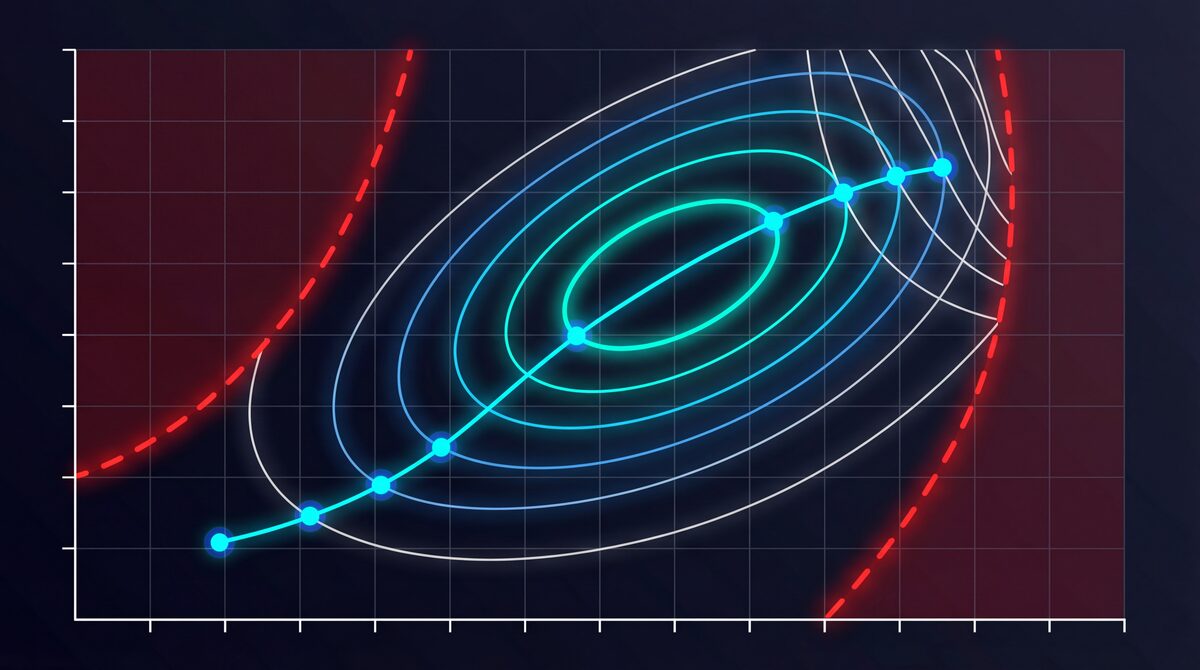
A compressor map is the most important data sheet a turbo manufacturer publishes. It shows the compressor's airflow capacity, efficiency, and operating limits across its entire range. Every turbo purchase should start with plotting your engine's requirements on the compressor map.
The Axes
- X-axis — Corrected Airflow (lb/min): The mass of air flowing through the compressor, corrected for standard temperature and pressure conditions. This is the horizontal dimension of the map — further right means more airflow.
- Y-axis — Pressure Ratio: The ratio of absolute outlet pressure to absolute inlet pressure. A pressure ratio of 2.0 means the compressor doubles the absolute air pressure. At sea level (14.7 psi atmospheric), a pressure ratio of 2.0 equals 14.7 psi gauge boost (14.7 × 2.0 = 29.4 psi absolute, minus 14.7 atmospheric = 14.7 gauge). Higher on the Y-axis means more boost.
The Boundaries
- Surge line (left boundary): A steep curve on the left side of the map. If your engine operates to the left of this line, the compressor stalls — airflow actually reverses momentarily, creating the distinctive "compressor surge" flutter sound. This is damaging to the compressor wheel and bearings. It happens when you're trying to maintain high boost at low airflow — typically during part-throttle driving in a high gear, or if the turbo is massively oversized for the engine.
- Choke line (right boundary): The vertical drop-off on the right side. Past this point, the compressor physically cannot flow more air regardless of turbine energy input. The air reaches sonic velocity at the inducer, and efficiency plummets. If your power target requires airflow past the choke line, you need a bigger turbo.
Efficiency Islands
The concentric ovals in the center of the map show compressor efficiency — how much of the input energy goes into usefully compressing air versus wasting it as heat. Peak efficiency on modern turbos is typically 74-78%, shown by the innermost island. The further you operate from the center, the less efficient the compressor is, meaning hotter charge air temperatures for the same boost level.
You want your engine's operating line (the path it traces across the map from idle to redline) to pass through or near the peak efficiency island at the RPM range where you spend most of your time. For a street car, that's 3,000-5,500 RPM. For a track car, it might be 5,000-7,500 RPM.
Speed Lines
The curved arcs across the map show shaft RPM — typically labeled 80K, 100K, 120K, 140K, 160K. These tell you how fast the turbo needs to spin to produce a given pressure ratio at a given airflow. Every turbo has a maximum safe shaft speed; crossing the highest speed line on the map risks over-speeding the turbo, which can burst the compressor wheel.
Plotting Your Engine's Operating Line
To plot where your engine operates on the map, calculate airflow and pressure ratio at several RPM points using:
Airflow (lb/min) = (Displacement × RPM × VE × PR) / (2 × 1728 × R × T)
Where VE is volumetric efficiency (85-95% for most VW turbo engines), PR is pressure ratio, R is the specific gas constant for air, and T is inlet temperature. The simplified version for quick estimates:
Airflow ≈ (Displacement in liters × RPM × VE × Manifold Pressure in psi) / 5660
Plot these points at 1,000 RPM increments from your boost threshold RPM to redline. Connect them, and you have your operating line. If that line stays within the efficiency islands and between the surge and choke boundaries, the turbo is a good match.
A/R RATIO: THE DEEP DIVE
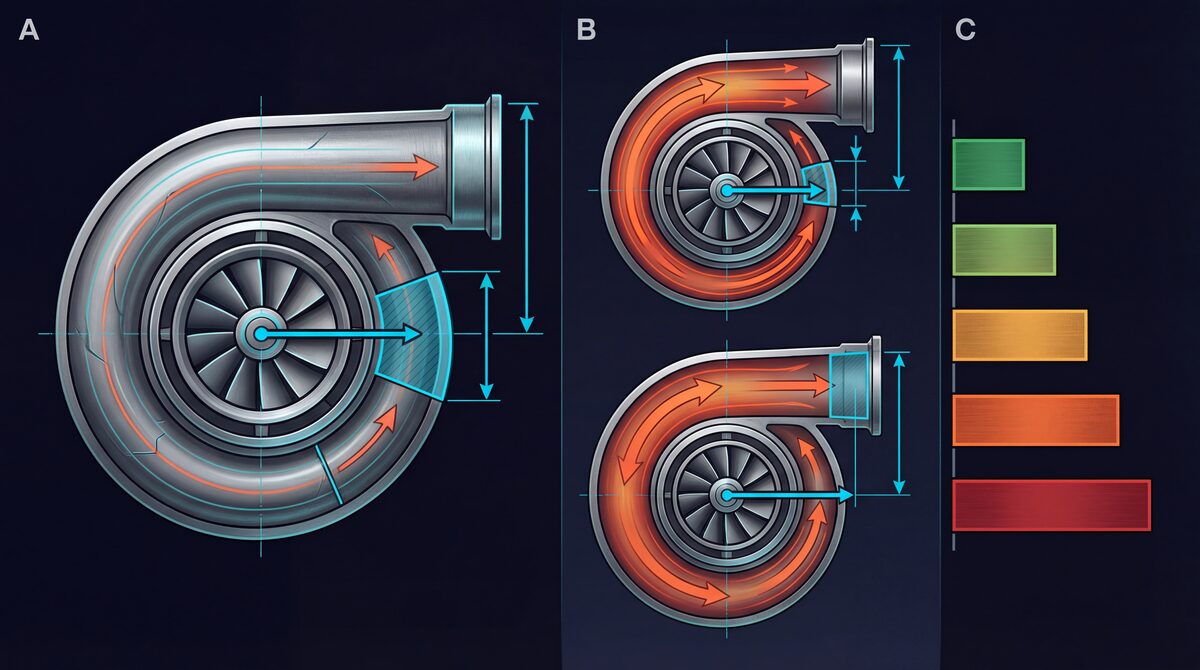
We introduced A/R in Chapter 1. Now let's go deeper, because this single specification has more impact on your car's driving character than any other turbo dimension.
The A/R ratio is calculated by taking the cross-sectional area (A) of the turbine housing's scroll passage at any point, and dividing it by the distance (R) from the centroid of that area to the center of the turbine wheel. Geometrically, it describes how tightly the exhaust gas is "wound" around the turbine.
How A/R Affects Performance
- Small A/R (0.48-0.63): The scroll passage is tight, which accelerates exhaust gas to high velocity before it hits the turbine blades. This means the turbo spools quickly — great for response. But at high RPM, the restrictive passage creates significant exhaust backpressure, which hurts top-end power and increases exhaust gas temperatures. The turbine acts like a cork in the exhaust at high flow rates.
- Mid-range A/R (0.63-0.96): This is the sweet spot for nearly all VW 4-cylinder and 5-cylinder turbo builds. A 0.63 A/R gives you a responsive street car that starts making boost by 2,800-3,200 RPM on a 1.8T/2.0T. A 0.82 A/R trades about 200-300 RPM of spool delay for meaningfully better top-end flow. A 0.96 pushes spool to 3,500-4,000 RPM but breathes freely to redline.
- Large A/R (0.96-1.75): Open scroll passages that let exhaust flow freely. The turbo takes longer to spool because exhaust velocity is lower, but top-end power is maximized. Backpressure stays low even at high RPM. This territory is for VR6 turbo builds, dedicated drag cars, and engines that live above 5,000 RPM.
The relationship between A/R and displacement is crucial. A 0.82 A/R housing on a 1.8L four-cylinder spools significantly later than the same 0.82 A/R on a 3.2L VR6, because the VR6 produces roughly 80% more exhaust volume at the same RPM. Larger displacement = more exhaust energy = faster spool at any given A/R.
| Engine | Displacement | Street A/R | Street/Track A/R | Full Race A/R |
|---|---|---|---|---|
| EA113 1.8T | 1.8L | 0.48 - 0.63 | 0.63 - 0.82 | 0.82 - 1.05 |
| EA888 2.0T | 2.0L | 0.63 | 0.63 - 0.82 | 0.82 - 1.05 |
| EA855 2.5 TFSI | 2.5L | 0.63 - 0.82 | 0.82 - 0.96 | 0.96 - 1.15 |
| VR6 12V/24V | 2.8 - 3.2L | 0.82 | 0.82 - 1.05 | 1.05 - 1.52 |
| VR6 3.6L | 3.6L | 0.82 - 0.96 | 0.96 - 1.15 | 1.15 - 1.75 |
HOUSING CONFIGURATIONS AND FLANGES
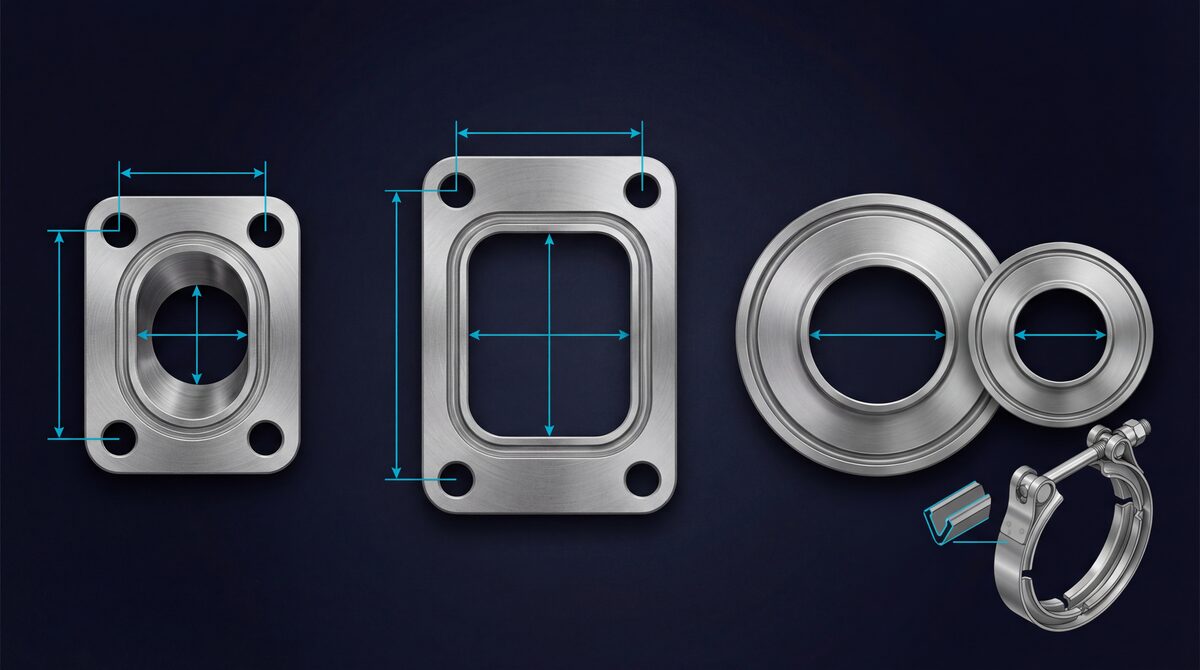
The turbine housing connects to the exhaust manifold via a flange — and you need to make sure the turbo's inlet flange matches your manifold. Here are the configurations you'll encounter in VW/Audi applications:
T3 Flange
The T3 is the most common flange in the VW turbo world. It's a 4-bolt rectangular pattern with an approximately 63mm × 79mm inlet opening. Nearly every aftermarket exhaust manifold for the EA113 1.8T (from ATP, CTS Turbo, 034 Motorsport, and others) uses a T3 inlet flange. The Precision Turbo Next Gen 5658, 5662, 6062, and 6266 are all available in T3 configurations, making them direct bolt-on upgrades with aftermarket manifolds.
T3 housings are available in two discharge styles: 4-bolt (traditional downpipe flange) and V-band discharge (circular clamp). V-band discharge is easier to install and remove, makes a better seal, and is preferred on modern builds. If you're buying a new turbo for a VW, choose V-band discharge unless your existing downpipe specifically requires a 4-bolt connection.
T4 Flange
The T4 has a larger 4-bolt rectangular pattern (approximately 75mm × 90mm inlet), allowing more exhaust flow. It's required for larger frame turbos — the Precision Turbo Next Gen 6466 and above use T4 inlet flanges. If you're upgrading from a T3 turbo to a T4 turbo, you'll need a new exhaust manifold or a T3-to-T4 adapter plate (available from ATP and others, though a dedicated T4 manifold is always the cleaner solution).
V-Band Inlet
V-band inlet flanges use a circular groove and a stainless steel clamp to connect the turbo to the manifold. They offer 360-degree sealing with no bolt alignment issues, easy installation and removal (one clamp vs. four bolts in a tight engine bay), and the ability to clock (rotate) the turbo housing to optimize downpipe routing. Precision Turbo offers V-band in/out configurations on most Next Gen models. This is the modern standard for new builds.
Divided/Twin-Entry
Divided turbine housings have two separate inlet ports, keeping exhaust pulse groups separated all the way to the turbine wheel. On a VW inline-4, this means cylinders 1+4 feed one port and cylinders 2+3 feed the other (matching the firing order). The exhaust manifold must have separate runners for each group — a divided manifold design rather than a single-collector. Divided housings are available in T4 divided configurations from Precision Turbo in a wide range of A/R ratios (0.70 through 1.75).
Note: the stock VW/Audi IS20 and IS38 turbos on the EA888 Gen3 are single-scroll designs. Twin-scroll/divided configurations are primarily found on aftermarket turbo setups or on other OEM platforms such as the IHI turbos used on the Audi B9 S4/S5 EA839 3.0T.
SINGLE TURBO VS TWIN TURBO
On inline engines (4-cylinder, 5-cylinder, VR6), a single turbo is nearly always the right choice. The benefits are overwhelming: simpler plumbing, easier tuning, lower cost, better packaging in transverse VW engine bays, and equal or better performance when properly sized.
Twin turbo setups make sense in two scenarios:
- Parallel twins on V-engines: Audi's 2.9 TFSI and 4.0 TFSI use two identical turbochargers, one per cylinder bank. Each turbo only handles half the cylinders, which means smaller turbos with faster spool. This is the OEM approach for Audi RS models — it works because each turbo has a direct, short path to its cylinder bank's exhaust manifold.
- Sequential/compound setups: A small turbo for low-RPM response and a large turbo for high-RPM power, with a bypass system to transition between them. This is complex, expensive, and rare on VW platforms. A single properly-sized turbo with a well-chosen A/R ratio accomplishes the same goal with far less complexity.
For every VW inline-4, inline-5, and VR6 build covered in this guide, single turbo is the assumed configuration.
PRECISION TURBO NEXT GEN — VW/AUDI RECOMMENDATIONS
Based on the current Precision Turbo Next Gen lineup and real-world VW/Audi builds, here's what we recommend for each platform. All models feature CEA 7x7 billet compressor wheels, Air-Cooled Dual Ceramic Ball-Bearing (ACBB) center sections, and redesigned ported shroud inlets with 10% improved flow over the previous Gen 2 series.
EA113 1.8T / EA888 2.0T (4-Cylinder)
| Build Type | Turbo | HP Target | Housing | Base Price |
|---|---|---|---|---|
| Budget daily | Next Gen 5658 | 350-450 WHP | T3, 0.63 A/R | $1,894 |
| Street performance | Next Gen 5662 | 400-500 WHP | T3, 0.63-0.82 A/R | $1,894 |
| Aggressive street | Next Gen 6062 | 450-550 WHP | T3, 0.82 A/R | $2,004 |
| Weekend track | Next Gen 6266 | 500-650 WHP | T3, 0.82 A/R | $2,101 |
| Dedicated track | Next Gen 6466 | 600-750 WHP | T4, 0.81 A/R | $2,454 |
VR6 2.8L / 3.2L / 3.6L (6-Cylinder)
| Build Type | Turbo | HP Target | Housing | Base Price |
|---|---|---|---|---|
| Street VR6T | Next Gen 6062 | 450-550 WHP | T3, 0.82 A/R | $2,004 |
| Performance VR6T | Next Gen 6266 | 550-700 WHP | T3 or T4, 0.82-1.05 A/R | $2,101 |
| Race VR6T | Next Gen 6670 | 700-900 WHP | T4, 1.00-1.15 A/R | $2,745 |
| Big power VR6T | Next Gen 7275 | 900-1,200 WHP | T4 divided, 1.15-1.52 A/R | $2,928 |
Read the full 2.5 TFSI Build Guide — RS3/TTRS platform, 5-cylinder turbo builds to 900+ WHP →
EA855 2.5 TFSI (5-Cylinder)
| Build Type | Turbo | HP Target | Housing | Base Price |
|---|---|---|---|---|
| Hybrid upgrade | Next Gen 6266 | 500-650 WHP | T3, 0.82 A/R | $2,101 |
| Big turbo | Next Gen 6670 | 650-850 WHP | T4, 0.81-0.96 A/R | $2,745 |
| Race build | Next Gen 7275 | 850-1,100 WHP | T4, 0.96-1.15 A/R | $2,928 |
Prices shown are base turbo without turbine housing. Add $250-$600 for the housing depending on material (cast iron vs. stainless steel) and configuration (undivided vs. divided). Stainless V-band housings carry a $178-$238 premium but are worth it for the corrosion resistance and V-band convenience.
GEN 2 TO NEXT GEN UPGRADE PATH
If you're running an older Precision Turbo Gen 2 model and considering an upgrade, every Gen 2 turbo has a direct Next Gen replacement with approximately 10% more airflow, improved compressor efficiency, and ball bearing center sections:
| Old Gen 2 | Next Gen Replacement | Flow Gain | HP Rating |
|---|---|---|---|
| Gen 2 5558 | Next Gen 5658 | +10% | 770 HP |
| Gen 2 5862 | Next Gen 5662 / 6062 | +10% | 800 / 840 HP |
| Gen 2 6062 | Next Gen 6062 | +10% | 840 HP |
| Gen 2 6266 | Next Gen 6266 | +10% | 925 HP |
| Gen 2 6466 | Next Gen 6466 | +10% | 1,000 HP |
| Gen 2 6870 | Next Gen 6870 | +10% | 1,200 HP |
| Gen 2 7275 | Next Gen 7275 | +10% | 1,380 HP |
| Gen 2 7675 | Next Gen 7675 | +10% | 1,480 HP |
All Next Gen models are direct drop-in replacements for their Gen 2 equivalents — same CHRA dimensions, same housing bolt patterns. If your current manifold and downpipe fit a Gen 2 6266, they'll fit the Next Gen 6266.
INTERACTIVE: TURBO SIZER CALCULATOR
Select your engine displacement, target power, and fuel type to see which Precision Turbo Next Gen models fit your build.
How do I know if my turbo is too small?
The telltale signs: boost pressure tapers off or even drops at high RPM instead of holding steady, exhaust gas temperatures climb rapidly above 5,500 RPM, and your air/fuel ratio leans out at the top of the rev range despite adequate fuel system capacity. On a datalog, you'll see the compressor operating past the choke line on the compressor map — the turbo physically cannot flow more air, so power plateaus. If your turbo is making full boost but power stops climbing, the compressor has run out of map.
Can I just get the biggest turbo possible for "future-proofing"?
This is one of the most common mistakes in the VW turbo community. An oversized turbo on a small-displacement engine creates terrible lag (no boost until 4,500+ RPM on a 1.8T), operates in the low-efficiency part of the compressor map at street power levels (meaning hotter charge temps for the same boost), and is prone to compressor surge during part-throttle driving. A turbo that makes 925 HP on paper is only useful if your engine, fuel system, and drivetrain can handle 925 HP. Match the turbo to your actual build — not a hypothetical future build that may never happen.
What's the difference between T3 and T4 flanges?
T3 and T4 refer to the turbine housing inlet flange size and bolt pattern. T3 is the smaller flange (~63mm × 79mm opening) used on most VW/Audi 4-cylinder turbo builds — it matches the vast majority of aftermarket exhaust manifolds for the EA113 1.8T and is available on Precision Turbo models up to the 6266. T4 is the larger flange (~75mm × 90mm opening) required for bigger frame turbos (6466 and up). Switching from a T3 turbo to a T4 turbo requires either a new exhaust manifold with a T4 flange or a T3-to-T4 adapter plate.
Should I get an SCP or HP compressor cover?
For VW transverse engine bays (MK1 through MK8), SCP (Standard Cast Ported) with its 2.5" outlet is almost always the right choice. The compact dimensions fit better in the tight confines of a front-wheel-drive engine bay. The HP (High Performance) cover has a 3.0" outlet for maximum flow, but the larger physical size requires custom charge piping routing and may not fit without cutting or modifying the engine bay. HP covers are best suited for dedicated race cars with custom engine bay work, longitudinal installs, or engine-swapped rear-engine builds where space isn't a constraint.
How much does a complete turbo kit cost for a VW?
A turbo-only purchase (turbo + housing, no manifold or piping) from Precision Turbo ranges from about $2,150 for a Next Gen 5658 with a basic T3 housing to $3,500+ for a Next Gen 7275 with a stainless V-band housing. A complete turbo kit — including exhaust manifold, downpipe, charge piping, oil lines, and hardware — runs $3,500-$6,000 from brands like ATP, CTS Turbo, and 034 Motorsport. Budget another $1,000-$2,500 for supporting mods (injectors, fuel pump, intercooler) and $500-$1,500 for a professional ECU tune. Total all-in cost for a properly done turbo upgrade on a VW: $5,000-$12,000 depending on power goals and starting platform.
INTERCOOLING
Compressing air heats it up — that's thermodynamics, not a design flaw. An intercooler's job is to cool that compressed charge air before it enters the engine, recovering air density and preventing detonation. Get this wrong and you're leaving 30-50 HP on the table.
COLLAPSEWHY COMPRESSED AIR IS HOT
When a turbocharger compresses air, it doesn't just increase pressure — it adds heat. This is called adiabatic compression, and the temperature rise is directly proportional to the pressure ratio. The formula from Corky Bell's Maximum Boost:
T_out = T_in × (PR)^((γ-1)/γ)
Where T is absolute temperature (Rankine), PR is the pressure ratio, and γ (gamma) is approximately 1.4 for air. In practical terms:
| Boost (Gauge) | Pressure Ratio | Ambient 70°F → Comp. Outlet | Temp Rise |
|---|---|---|---|
| 7 psi | 1.48 | ~155°F | +85°F |
| 15 psi | 2.02 | ~230°F | +160°F |
| 20 psi | 2.36 | ~270°F | +200°F |
| 25 psi | 2.70 | ~310°F | +240°F |
| 30 psi | 3.04 | ~345°F | +275°F |
At 25 psi of boost — a common target for aggressive VW/Audi builds — the air leaving the compressor is over 300°F. At those temperatures, air density drops significantly (hot air is less dense than cold air), and detonation risk climbs dramatically. Every 10°F increase in charge temperature costs approximately 1.5% in power, because there are fewer air molecules per unit volume entering the cylinders.
This is why intercooling isn't optional on any serious turbo build. Even at a mild 15 psi, you're dealing with 230°F charge temps without an intercooler — dangerously close to detonation territory on pump gas.
INTERCOOLER EFFICIENCY
Intercooler efficiency measures how much of the temperature rise the intercooler removes. The formula:
Efficiency = (T_hot_in - T_hot_out) / (T_hot_in - T_ambient) × 100
A 100% efficient intercooler would cool the charge air all the way down to ambient temperature — physically impossible, but the closer you get, the better. Here's what different efficiency levels look like in practice at 25 psi boost on a 70°F day (310°F compressor outlet):
| Intercooler Type | Efficiency | Charge Temp Out | Density Recovery |
|---|---|---|---|
| Stock VW side-mount | 50-65% | 154-190°F | Moderate — heat soaks in 2 pulls |
| Decent aftermarket FMIC | 70-85% | 106-142°F | Good for street power |
| High-quality FMIC | 85-95% | 82-106°F | Excellent — near ambient on first pull |
| Air-to-water (track) | 85-95% | 82-106°F | Consistent across multiple pulls |
AIR-TO-AIR FRONT MOUNT INTERCOOLER (FMIC)
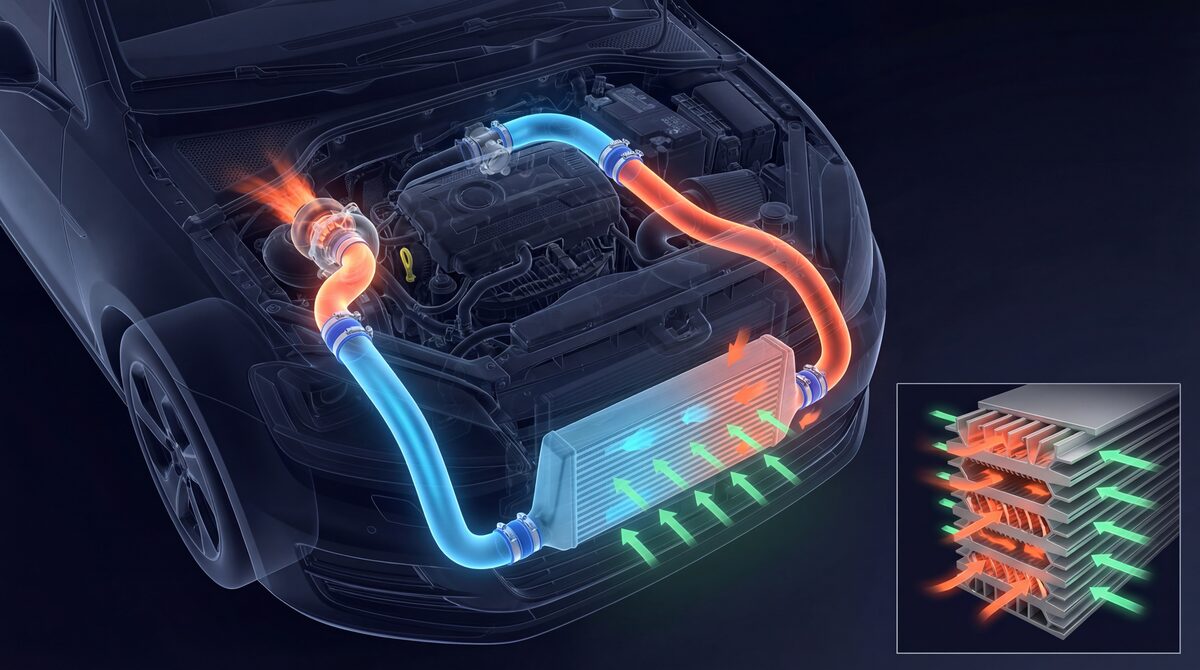
The air-to-air front mount intercooler is the standard choice for VW/Audi turbo builds. Hot compressed air exits the turbo, travels through charge piping to a large core mounted behind the front bumper, passes through the core where ambient airflow cools it, then returns through piping to the throttle body.
Core Types
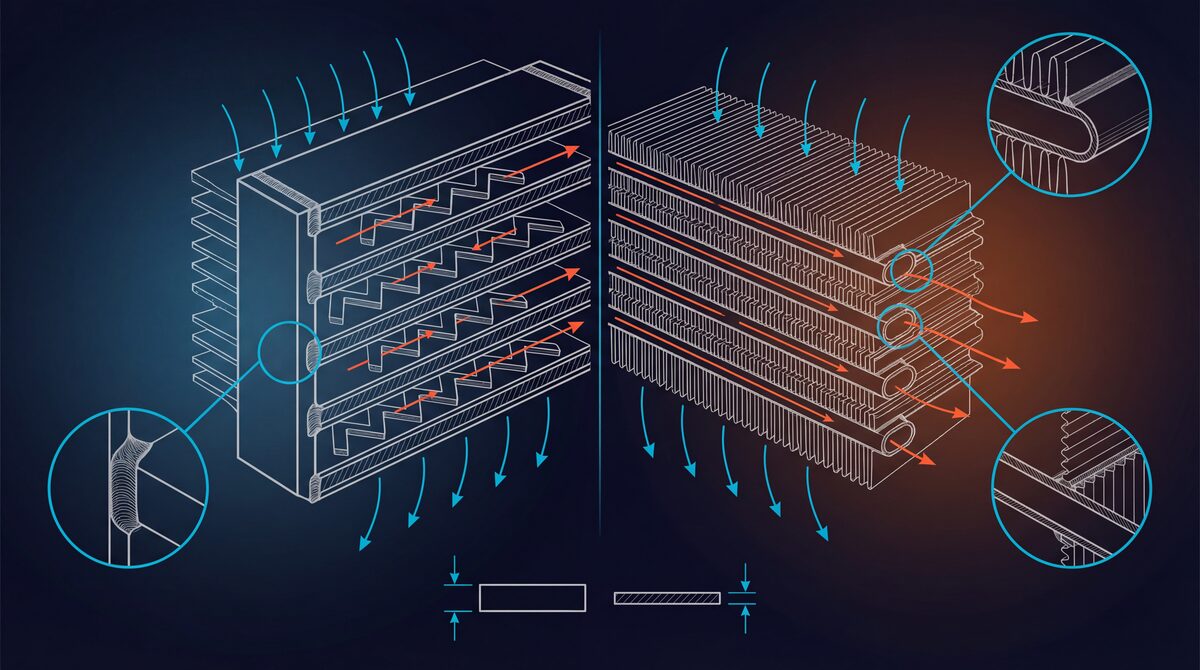
- Bar-and-plate: Thick aluminum plates with internal turbulators (offset fins and ridges that create turbulence for better heat transfer), separated by heavy bars. Stronger under boost pressure, better thermal capacity, heavier, and more expensive. This is the correct choice for any build above 350 WHP.
- Tube-and-fin: Thin oval tubes carrying charge air, with corrugated louvered fins in between for ambient air channels. Lighter, cheaper, adequate for moderate power levels (under 350 WHP). Less structurally robust — the thin tubes can balloon or burst under high boost pressure.
Sizing
A useful rule of thumb: core volume should be approximately 1 cubic inch per target horsepower. A core that's 27" wide × 7" tall × 3.5" deep = 661 cubic inches — good for a 600-650 WHP build. More core volume is generally better (more thermal mass, more surface area), but there are diminishing returns — and a massive core with tight fin density creates excessive pressure drop.
Piping Diameter
| Power Level | Pipe Diameter | Notes |
|---|---|---|
| Under 400 WHP | 2.5" | Standard for most VW turbo kits |
| 400-600 WHP | 2.75" - 3.0" | Common upgrade for big turbo builds |
| 600+ WHP | 3.0" - 3.5" | Requires custom routing in most VW bays |
VW-Specific: The Stock Intercooler Problem
The stock MK7/MK7.5 GTI intercooler is a small side-mount unit that's adequate for stock power and barely survives a Stage 1 tune. By Stage 2, it's a liability — heat soak after a single aggressive pull means the ECU pulls timing on the next pull, and you'll see 20-30 WHP less on a back-to-back dyno run. This is the single most impactful upgrade for any MK7 GTI owner beyond a tune. Popular upgrades from Wagner Tuning, ECS, CTS Turbo, and Integrated Engineering solve the problem completely with front-mount bar-and-plate cores.
AIR-TO-WATER INTERCOOLING
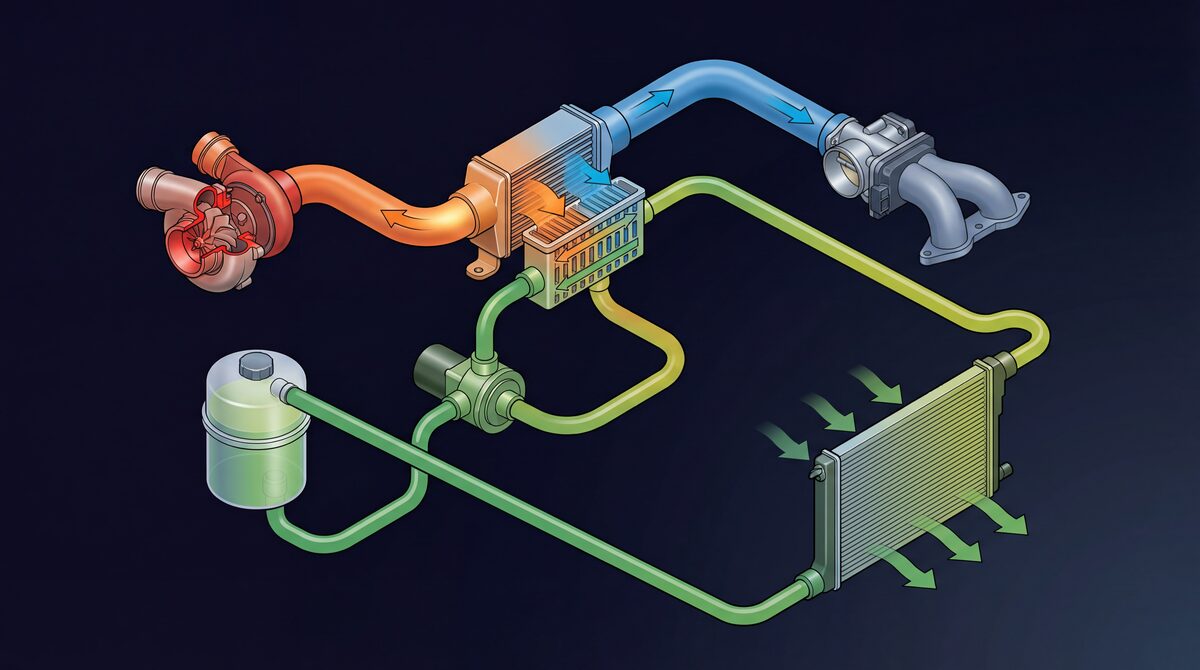
An air-to-water system uses a separate coolant loop to cool the charge air. Hot compressed air passes through a compact water-to-air heat exchanger (often mounted on or near the intake manifold), where it transfers heat to coolant circulating through a dedicated loop with its own pump, reservoir, and front-mounted radiator.
Advantages
- Shorter charge pipes: The heat exchanger mounts near the engine, so the total charge pipe volume is much smaller. Less volume = faster boost response (less pipe to pressurize).
- Consistent temps on repeated pulls: Water has enormous thermal mass compared to air. The coolant absorbs heat across multiple pulls without significant temperature rise, then gradually rejects it through the front radiator. This means your fifth pull on a drag strip is nearly as cool as your first.
- Packaging flexibility: The compact heat exchanger fits in spaces where a traditional FMIC can't, and the coolant lines can be routed around obstacles more easily than rigid charge pipes.
Disadvantages
- Complexity: More components = more failure points. An electric pump, reservoir, thermostat, heat exchanger, front radiator, and all associated plumbing.
- Cost: A quality air-to-water setup costs 2-3x more than an equivalent FMIC. Budget $2,000-$4,000 for a complete kit.
- Weight: The coolant, reservoir, pump, and heat exchanger add 15-30 lbs over an FMIC setup.
Air-to-water intercooling is the right choice for drag racing (where consistent temps across multiple runs matter most), packaging-constrained builds, and high-power applications where the charge pipe volume of an FMIC setup creates unacceptable lag. For most street and road-course VW builds, a quality FMIC is simpler, cheaper, and equally effective.
One-Shot Ice Water Systems
In drag racing, some builders fill the air-to-water reservoir with ice water (or a water/methanol ice slurry) before each run. The charge air passes through the heat exchanger at near-freezing coolant temperatures, producing charge air temps of 40-60°F — colder than ambient. This is legal in most classes and provides a measurable power advantage on a single pass. The ice melts during the run, and you refill between passes. Corky Bell covers this technique extensively in Maximum Boost.
PRESSURE DROP: THE HIDDEN KILLER
Every intercooler creates a pressure drop — the charge air enters at one pressure and exits at a lower pressure because the core's internal passages create flow resistance. The denser the core, the better it cools — but the more pressure it drops.
The impact is significant: 1 psi of pressure drop costs approximately 3-5% of your power, because the turbo has to work harder to maintain the target boost at the throttle body. A 2 psi drop across the intercooler at 20 psi target means the turbo has to produce 22 psi to deliver 20 psi to the engine — pushing the turbo higher on the compressor map, into less efficient territory, generating even more heat.
The optimal intercooler has less than 1 psi of pressure drop at your target airflow while still achieving 80%+ cooling efficiency. This is why the biggest intercooler isn't always the best — a massive core with extremely tight fin density might cool beautifully but create 3-4 psi of pressure drop that costs more power than the cooling gains.
Can I run a turbo without an intercooler?
Technically yes, but it's inadvisable above about 8-10 psi on pump gas. Without intercooling, charge air temperatures at 15+ psi will exceed 230°F, dramatically increasing detonation risk and reducing power. The only scenario where no intercooler makes sense is a very low-boost setup (under 8 psi) on an engine with a low compression ratio, or a drag car making a single pass where a water/methanol injection system provides supplemental cooling. For any street-driven VW, an intercooler is non-negotiable.
Should I upgrade my intercooler before going Stage 2?
On the MK7/MK7.5 GTI and Golf R, absolutely yes — the stock intercooler is the single biggest limiting factor after a Stage 2 tune. The stock side-mount unit heat soaks after one aggressive pull, causing the ECU to pull timing and reduce power by 20-30 WHP on subsequent pulls. A front-mount intercooler upgrade from Wagner, CTS, or IE should be your first supporting mod after a tune. On the older MK4 1.8T with a front-mount factory intercooler, the stock unit is adequate for mild Stage 2 builds but should be upgraded for anything beyond.
What's better: air-to-air or air-to-water?
For most VW/Audi builds, air-to-air (FMIC) is the better choice. It's simpler, cheaper, lighter, and nearly as effective for street and road-course driving. Air-to-water wins in two specific scenarios: drag racing (where consistent temps across multiple runs matter) and tight packaging (where FMIC piping can't be routed). Unless you're building a dedicated drag car or dealing with unusual packaging constraints, stick with a quality FMIC.
FUEL INJECTORS
A turbo is only as powerful as the fuel system feeding it. More air demands more fuel — and the injectors are the final link between your fuel system and the combustion chamber. Understanding injector sizing, duty cycle, and the port-versus-direct injection evolution on VW/Audi engines is critical for any build above stock power levels.
COLLAPSE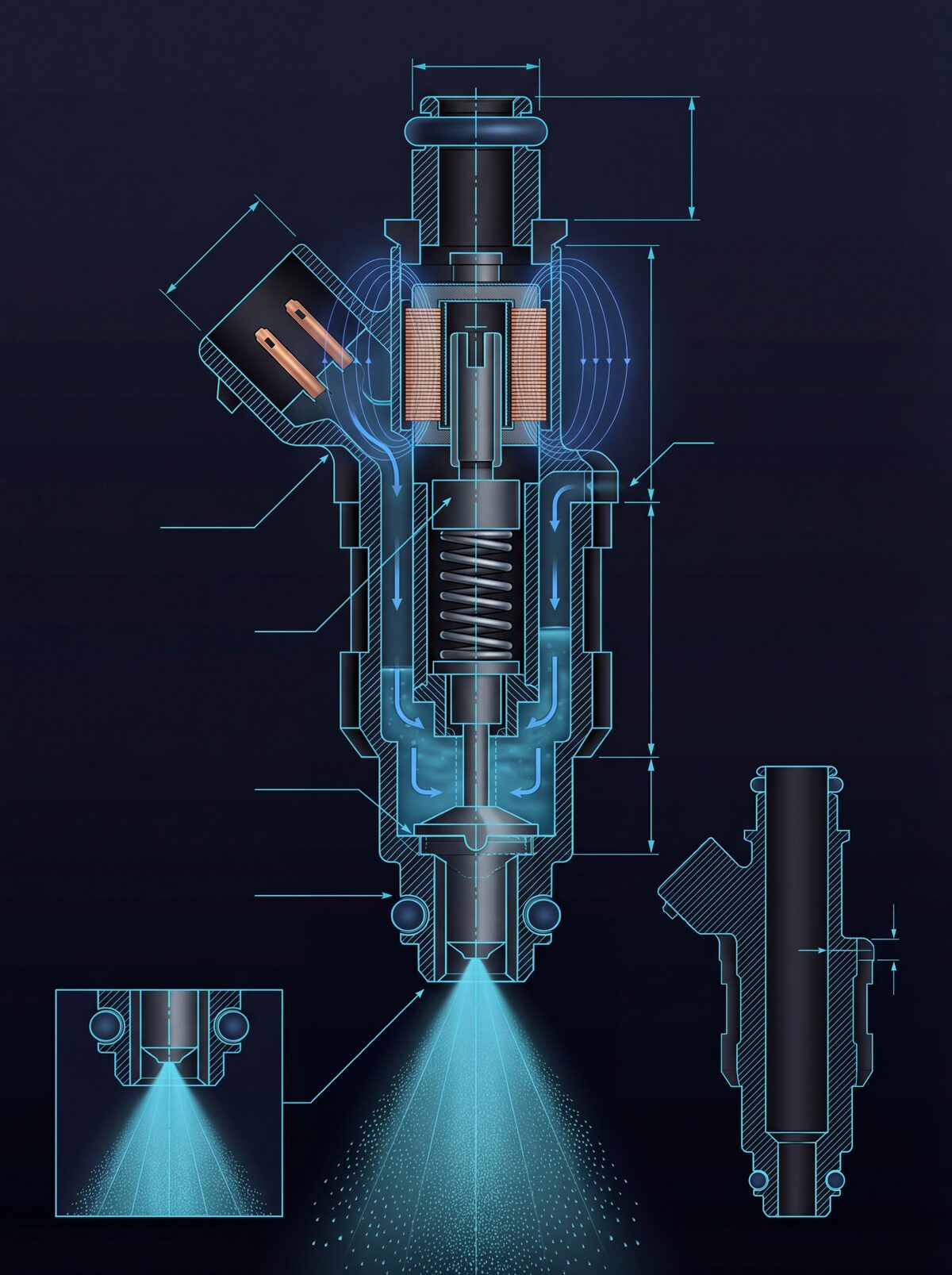
HOW FUEL INJECTORS WORK
A fuel injector is a solenoid-actuated valve. When the ECU sends an electrical pulse, an electromagnetic coil energizes and lifts an armature connected to a pintle (needle valve) off its seat, allowing pressurized fuel to spray into the intake port or directly into the combustion chamber. When the pulse ends, a spring pushes the pintle back onto its seat, stopping fuel flow. This happens thousands of times per minute at redline — a 4-cylinder engine at 7,000 RPM fires each injector 3,500 times per minute.
The critical specifications are flow rate (how much fuel per unit time), spray pattern (how the fuel atomizes), response time (how quickly the injector opens and closes), and impedance (the electrical characteristics that determine how the ECU drives it).
PORT INJECTION VS DIRECT INJECTION
Port Injection (PFI)
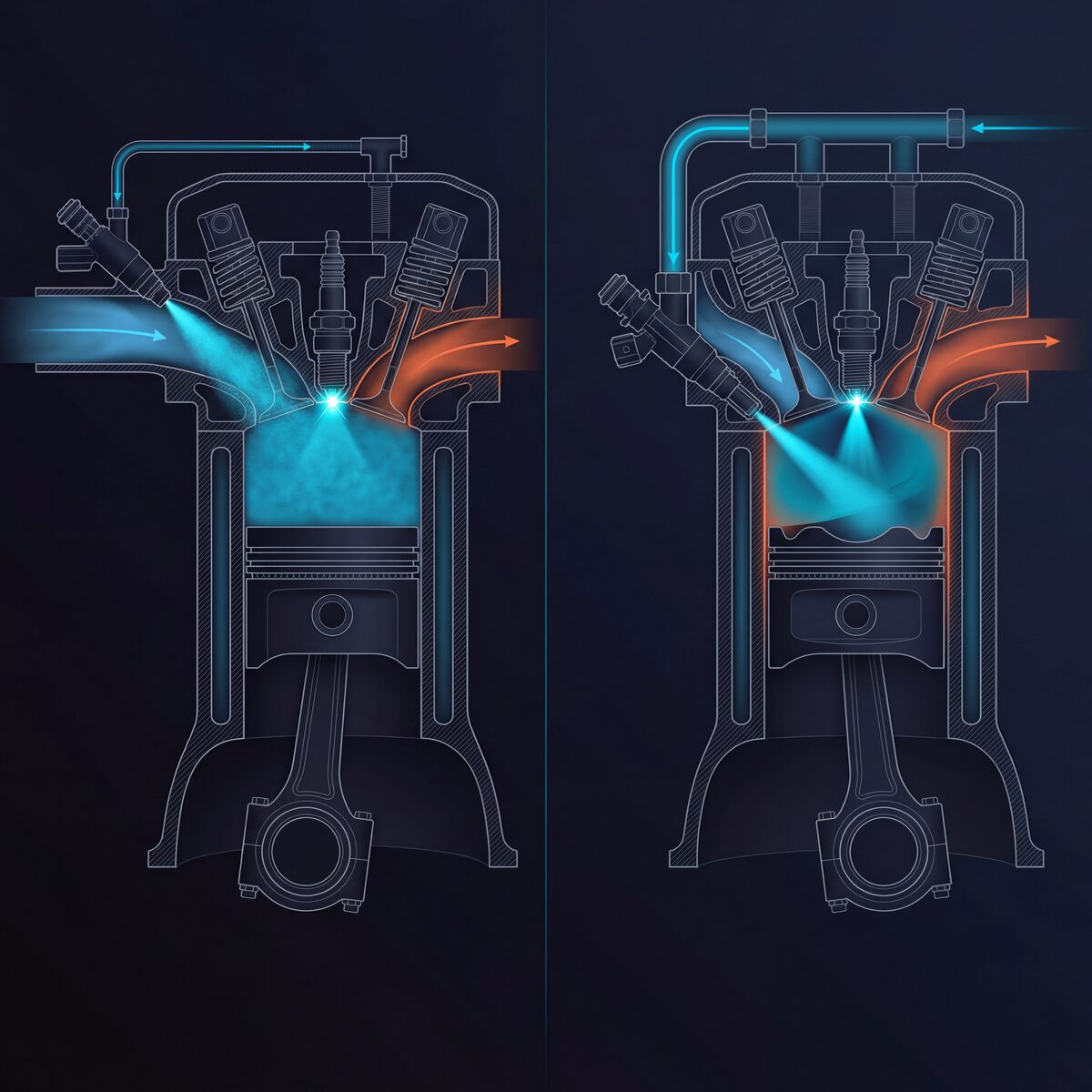
Port injection places the injector in the intake runner, spraying fuel onto the back of the intake valve at relatively low pressure (3-4 bar / 43.5-58 psi). The fuel mixes with incoming air in the intake port and enters the cylinder as the valve opens. This is the system used on the EA113 1.8T, early VR6 engines, and the port injector side of the dual-injection EA888 Gen3B+.
- Advantage: Fuel washing — the fuel spray cleans the back of the intake valve, preventing carbon buildup. Simpler and cheaper fuel system (low-pressure pump only). Aftermarket injector upgrades are straightforward bolt-in replacements.
- Disadvantage: Less precise fuel metering (fuel can pool on manifold walls at low temps or during transients). Lower combustion efficiency than DI at the same compression ratio.
Direct Injection (DI / FSI)
Direct injection places the injector directly in the combustion chamber, spraying fuel at extremely high pressure (150-350 bar / 2,175-5,075 psi on VW/Audi systems). The fuel is injected directly into the cylinder, where it atomizes and mixes with the air charge.
- Advantage: Charge cooling effect — fuel evaporating inside the cylinder absorbs heat, effectively lowering charge temperature. This allows higher compression ratios (and thus better efficiency) without detonation. More precise fuel delivery for better emissions and fuel economy.
- Disadvantage: Carbon buildup on intake valves — because fuel never touches the valve, carbon deposits from PCV and EGR gases accumulate on the valve stems and faces. This is the notorious "carbon problem" on VW/Audi DI engines. Expensive high-pressure fuel pump (HPFP) required. Aftermarket injector upgrades are more complex.
VW/Audi Dual Injection Evolution
VW's answer to the DI carbon problem is dual injection — combining both port and direct injection on the same engine:
- EA888 Gen1/Gen2: Direct injection only. Carbon buildup is a guaranteed maintenance item — walnut blasting every 40,000-60,000 miles.
- EA888 Gen3 (2013-2016 in US): Still direct injection only. Despite the platform update, early Gen3 engines did NOT have dual injection. MK7 GTI owners with 2015-2016 model years still face the carbon problem.
- EA888 Gen3B (~2017+): Added the "MPI + FSI" dual injection system described in VW's SSP436 training document. Port injectors fire at low load to keep valves clean. Direct injectors handle precision fueling at high load. Both fire simultaneously at full power for maximum fuel delivery. This is the configuration on later MK7.5 GTI and all MK8 GTI/Golf R models.
This distinction matters enormously for tuning and upgrades. On DI-only engines, the fuel system's power ceiling is determined by the HPFP capacity and DI injector flow rate. On dual-injection engines, the port injectors provide a secondary fueling path that can supplement the DI system at high power levels.
INJECTOR FLOW RATE AND SIZING
Injector flow rate is measured in cc/min (cubic centimeters per minute) at a standard test pressure — typically 3 bar (43.5 psi) for port injectors. The higher the flow rate, the more fuel the injector can deliver per firing event. Here's how common injector sizes map to VW power levels:
| Injector | Flow Rate | Max HP (4-cyl, gasoline) | Max HP (4-cyl, E85) |
|---|---|---|---|
| Stock EA113 1.8T (180HP) | 315 cc/min | ~250 WHP | Not recommended |
| Stock EA113 1.8T (K04) | 386 cc/min | ~300 WHP | ~230 WHP |
| Bosch 550cc | 550 cc/min | ~420 WHP | ~320 WHP |
| Bosch 630cc | 630 cc/min | ~480 WHP | ~370 WHP |
| Injector Dynamics ID725 | 725 cc/min | ~550 WHP | ~425 WHP |
| Injector Dynamics ID1050x | 1,050 cc/min | ~800 WHP | ~615 WHP |
| Injector Dynamics ID1700x | 1,700 cc/min | ~1,300 WHP | ~1,000 WHP |
The Sizing Formula
To calculate required injector flow rate:
Flow Rate (lb/hr) = (Target HP × BSFC) / (# Cylinders × Max Duty Cycle)
Where BSFC is typically 0.50 lb/hp/hr for tuned gasoline engines and 0.65 for E85, and max duty cycle is 0.80 (80%) for a safe daily limit.
Example: 400 WHP on gasoline, 4 cylinders:
- Flow Rate = (400 × 0.50) / (4 × 0.80) = 200 / 3.2 = 62.5 lb/hr ≈ 660 cc/min
This tells you Bosch 630cc injectors are borderline — they'd be running near 80% duty at peak power. Injector Dynamics ID725s give a comfortable margin. Always size up rather than down — you can always reduce injector pulse width via tuning, but you can't flow more fuel than the injector's physical limit.
DUTY CYCLE: WHY 80% IS THE LIMIT
Duty cycle is the percentage of time an injector is open during each firing event. At idle, duty cycle might be 5-10%. At wide-open throttle near redline, it can reach 70-90%. The generally accepted safe limit for sustained operation is 80%.
Above 80% duty cycle, the injector doesn't have enough closed time to fully reset — the pintle may not seat completely, leading to dribbling (poor atomization) and inconsistent fuel delivery. At 95%+, the injector is essentially held open continuously, which means it can't modulate fuel delivery at all. If your datalogs show duty cycles above 85% at redline, you need larger injectors — you've run out of headroom.
The critical point: duty cycle is highest at redline because the firing events happen fastest. A 4-cylinder at 7,000 RPM has 3,500 firing events per minute on each cylinder — each injector pulse is only about 17 milliseconds. The injector needs to open, deliver fuel, close, and reset in that window. Higher power demands longer open time, and at some point you hit the physical wall.
INJECTOR IMPEDANCE
Injectors come in two electrical types:
- High-impedance (12+ ohm, "saturated drive"): The ECU applies a constant voltage. The high resistance limits current naturally. All VW/Audi factory ECUs are designed to drive high-impedance injectors. Most aftermarket upgrade injectors (Bosch 550cc, 630cc, Injector Dynamics ID series) are high-impedance and plug directly into the stock harness.
- Low-impedance (2-3 ohm, "peak-and-hold"): Requires a specialized driver that sends a high initial current to open the injector quickly, then drops to a lower holding current. These respond faster but need a resistor box or peak-and-hold driver to work with a VW ECU. Rarely used in VW builds — avoid unless your tuner specifically recommends them.
PLATFORM-SPECIFIC INJECTOR UPGRADES
EA113 1.8T
The 1.8T uses port injection with easy-to-replace EV14-style injectors. Upgrades are straightforward bolt-in replacements with a retune. Popular choices: Bosch 550cc for builds to ~420 WHP, Bosch 630cc for ~480 WHP, Injector Dynamics ID1050x for serious builds to ~800 WHP.
EA888 Gen3 (DI-Only)
On DI-only Gen3 cars, the stock high-pressure direct injectors are good to approximately 450-500 WHP. Beyond that, you need upgraded HPFP internals (Autotech, Nostrum) before considering injector upgrades. The HPFP is almost always the bottleneck before the injectors on DI platforms.
EA888 Gen3B+ (Dual Injection)
Dual injection cars have two upgrade paths: port injectors can be upgraded to ID1050x or similar for supplemental fueling, while the DI side benefits from HPFP upgrades. This dual path gives significant fueling headroom — some tuners use the port injectors as the primary fueling source at high power and the DI for precision timing.
VR6 Turbo
VR6 turbo conversions use port injection exclusively. With 6 cylinders, each injector handles less fuel than a 4-cylinder at the same power level. ID1050x injectors support ~600 WHP on a VR6T, and ID1700x or 2000cc injectors handle 800+ WHP builds.
INTERACTIVE: INJECTOR SIZING CALCULATOR
Enter your target power, cylinder count, and fuel type to calculate required injector flow rate and see which injectors fit.
Do I need to upgrade my injectors for a Stage 1 or Stage 2 tune?
For Stage 1 (ECU tune only, stock turbo) — no. The stock injectors have enough headroom for the modest power gains of a Stage 1 tune on any VW/Audi turbo platform. For Stage 2 (tune + downpipe + intake) — usually no for 4-cylinder cars, but check with your tuner. The stock EA113 1.8T injectors start running out of headroom around 280-300 WHP, which some aggressive Stage 2 tunes approach. EA888 DI injectors are fine for Stage 2. Injector upgrades become necessary when you upgrade the turbo beyond stock.
How do I know if I need E85 injectors?
E85 requires approximately 30% more fuel volume than gasoline for the same power output (lower energy density per gallon). If your current injectors support 400 WHP on gasoline, they'll only support about 310 WHP on E85. So if you're switching to E85 or a flex-fuel setup, multiply your target HP by 1.3 and size injectors for that number. Many serious VW builds use ID1050x injectors specifically because they provide enough flow for 600+ WHP on E85 while still atomizing well at idle (good low-flow linearity).
What causes carbon buildup on VW direct injection engines?
On direct injection engines, fuel is sprayed directly into the cylinder and never touches the intake valves. Meanwhile, oil vapors from the PCV (crankcase ventilation) system and exhaust gases from the EGR system coat the intake valve stems and faces with a carbonaceous residue. On port-injected engines, the fuel spray washes these deposits off. On DI-only engines, they accumulate over time, eventually restricting airflow and causing misfires, rough idle, and power loss. The fix is walnut blasting (media blasting the valves through the intake ports) every 40,000-60,000 miles — or upgrading to a dual-injection Gen3B+ engine where the port injectors keep the valves clean.
FUEL DELIVERY: LPFP & HPFP
Modern VW/Audi turbo engines use a two-stage fuel delivery system — a low-pressure pump in the tank and a high-pressure pump on the engine. Understanding both stages and their flow limits is critical, because the fuel system is almost always the first bottleneck on a tuned car.
COLLAPSETWO-STAGE FUEL DELIVERY
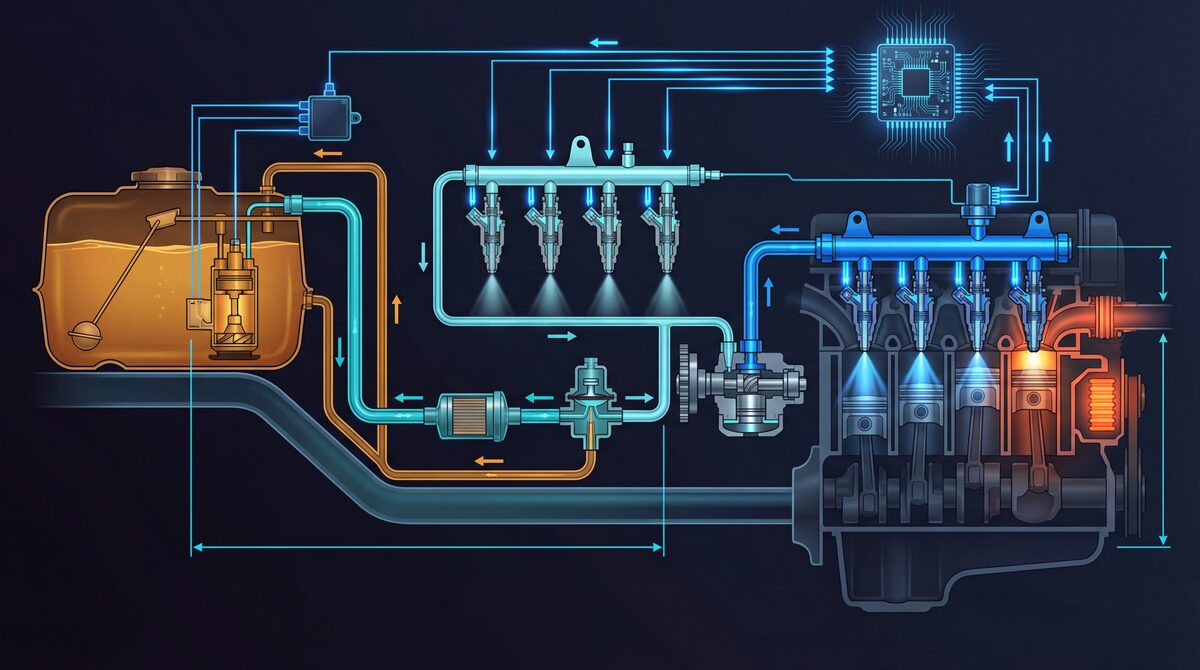
Every fuel-injected VW/Audi has at least a low-pressure fuel pump (LPFP). Direct-injection engines add a high-pressure fuel pump (HPFP) driven by the camshaft. Understanding this two-stage architecture is essential because each stage has its own flow limit, and the system is only as strong as its weakest link.
LOW-PRESSURE FUEL PUMP (LPFP)
The LPFP is an electric pump located inside the fuel tank, typically integrated into the fuel sender assembly. It draws fuel from the tank, pressurizes it to 3-5 bar (43.5-72.5 psi), and pushes it through the fuel lines to the engine bay. On port-injected engines like the EA113 1.8T, the LPFP feeds the injectors directly. On direct-injection engines, it feeds the HPFP.
The critical point: the HPFP can only compress what the LPFP delivers. If the LPFP can't maintain adequate supply pressure under high-demand conditions (wide-open throttle at high RPM), the HPFP starves and fuel rail pressure drops. This is often the first bottleneck on tuned VW/Audi cars — before the injectors run out, before the HPFP maxes out, the LPFP can't keep up.
Symptoms of LPFP Limitation
- Misfires at high RPM under boost (fuel cuts from low rail pressure)
- LPFP supply pressure drops below 4 bar on the datalog during WOT pulls
- Lean air/fuel ratio spikes at high RPM that correct immediately when you lift throttle
- Inconsistent power — first pull is strong, second pull is weaker (LPFP can't recover between pulls)
Upgrade Options
- Autotech LPFP (internals swap): Replacement internals that swap into the stock pump housing. No fuel tank modification needed. The most popular upgrade for MQB-platform cars. Good to ~500 WHP on gasoline.
- DeatschWerks DW300: 300 lph (liters per hour) replacement pump. Higher flow than stock, fits in the stock housing on most VW platforms. Good to ~550 WHP on gasoline.
- Walbro 450/525: High-flow racing pumps. 450 lph or 525 lph models. May require fuel hanger/basket modification for VW tank fitment. For builds above 600 WHP or E85 applications requiring maximum fuel volume.
HIGH-PRESSURE FUEL PUMP (HPFP)
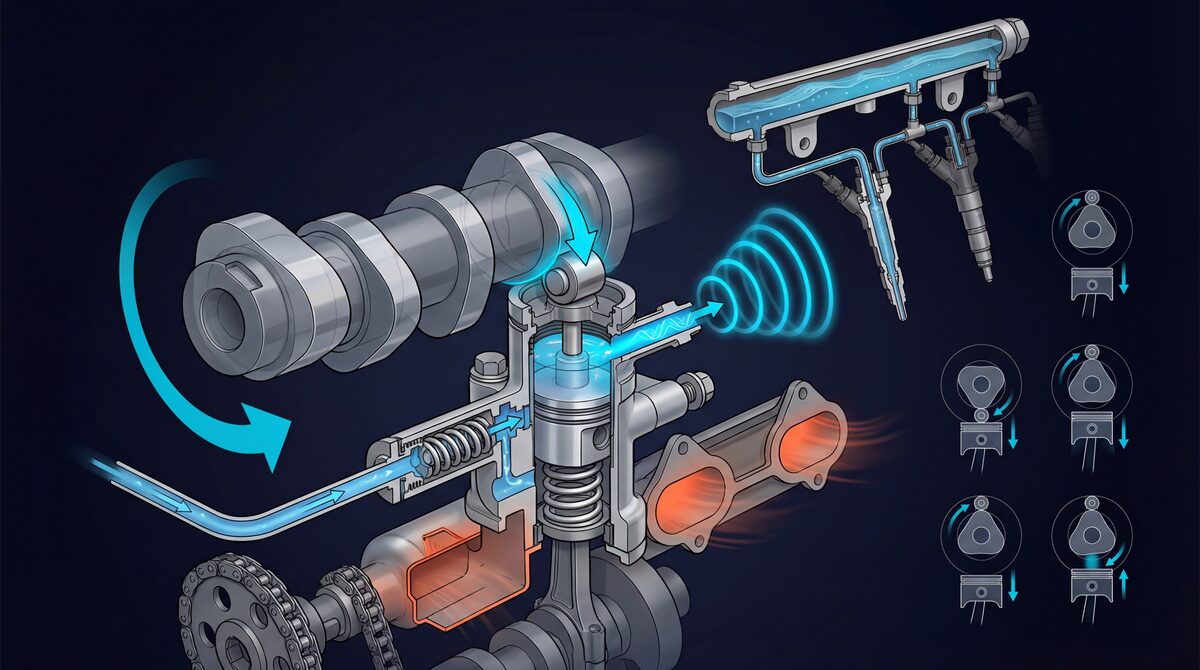
The HPFP is a mechanical pump driven by a dedicated lobe on the intake or exhaust camshaft. As the cam rotates, the lobe pushes a bucket tappet, which drives a piston inside the pump body. Each cam revolution produces one pump stroke — fuel enters the pump chamber at LPFP pressure (3-5 bar) through an inlet check valve, the piston compresses it to 150-350 bar, and it exits through an outlet check valve to the high-pressure fuel rail.
The stock EA888 Gen3 HPFP is good to approximately 350-400 WHP on gasoline. This is a hard limit — the piston displacement and cam lobe profile determine maximum fuel volume per stroke, and no amount of tuning can exceed the physical capacity of the pump.
HPFP Upgrades
| Upgrade | Type | Power Support | Notes |
|---|---|---|---|
| Autotech HPFP internals | Piston + spring swap | ~500-550 WHP (gas) | Most popular EA888 upgrade. Bolt-in, keeps stock housing. |
| IE HPFP internals | Piston + spring swap | ~500-550 WHP (gas) | Similar concept to Autotech, includes upgraded spring. |
| Nostrum HPFP | Complete pump replacement | ~600-650 WHP (gas) | Larger displacement piston, higher flow ceiling. |
| Dual HPFP conversion | Second pump added | ~800+ WHP | Requires custom cam lobe or auxiliary drive. For serious race builds. |
E85 AND FUEL VOLUME REQUIREMENTS
E85 has approximately 30% less energy per unit volume compared to gasoline. To make the same power, you need roughly 30% more fuel flowing through every part of the system — LPFP, HPFP, fuel lines, and injectors all need to support the additional volume.
This is why E85 builds often push the fuel system to its limits faster than gasoline builds. A car that's comfortable at 450 WHP on pump gas might run out of fuel system capacity at 350 WHP on E85. The math is straightforward: multiply your gasoline fuel system requirements by 1.3 for E85.
Many high-power VW builds solve this by adding port injection as a supplemental fueling path. The HPFP feeds the DI injectors at their stock capacity, and separate port injectors (fed by the LPFP) provide the additional fuel volume needed for big-power E85 tunes. This is the approach most tuners use for EA888 builds above 500 WHP on E85.
FUEL SYSTEM ARCHITECTURE BY POWER LEVEL
Using the EA888 Gen3 as the reference platform (the most commonly modified VW engine):
| Power Target | LPFP | HPFP | Injectors |
|---|---|---|---|
| Stock - 350 WHP | Stock | Stock | Stock DI |
| 350 - 500 WHP | Autotech / DW300 | Autotech / IE internals | Stock DI (add port for E85) |
| 500 - 700 WHP | DW300 / Walbro 450 | Nostrum / upgraded internals | Port injection 1050cc+ supplemental |
| 700+ WHP | Walbro 525 / dual LPFP | Dual HPFP conversion | Large port + large DI injectors |
How do I know if my LPFP is failing?
Log fuel pressure on the low-pressure side during a WOT pull using your ECU tuning software (VCDS, OBDeleven, or your tuner's logging tools). Stock LPFP should maintain 4+ bar under all conditions. If it drops below 3.5 bar during high-demand pulls, the LPFP is running out of capacity. Other symptoms: intermittent misfires only under boost at high RPM, lean spikes that correlate with fuel pressure drops, and the car running progressively worse on hot days (fuel pump efficiency drops with fuel temperature).
Can I upgrade the HPFP without a tune?
You can physically install upgraded HPFP internals without a tune, but it won't help — the stock ECU controls the HPFP output via a solenoid valve, and the stock calibration doesn't request more fuel than stock injectors can deliver. The HPFP upgrade only becomes useful when paired with a tune that requests higher fuel rail pressure or longer injector pulse widths. Always upgrade the HPFP as part of a coordinated tune + hardware package.
Is E85 worth it for my VW?
E85 provides roughly a 105-octane equivalent, allowing significantly more boost and ignition timing advance without detonation. Real-world gains on an EA888 Gen3 with the same IS20 turbo: ~310 WHP on 93 octane vs ~395 WHP on E85 — that's a 27% power increase from fuel alone. The trade-offs: 30% worse fuel economy (more fuel burned per mile), requires upgraded fuel system components for higher power builds, and E85 availability varies by region. If you have access to E85 and are building for maximum performance, it's one of the best power-per-dollar modifications available. A flex-fuel tune that auto-adjusts for any ethanol blend gives you the best of both worlds.
ENGINE MANAGEMENT & SOFTWARE
The ECU is the brain that ties every hardware upgrade together. Without proper tuning, a bigger turbo, larger injectors, and upgraded fuel pumps are just expensive paperweights. This chapter covers how ECU tuning works, what changes in a tune, and which companies do it right for VW/Audi platforms.
COLLAPSE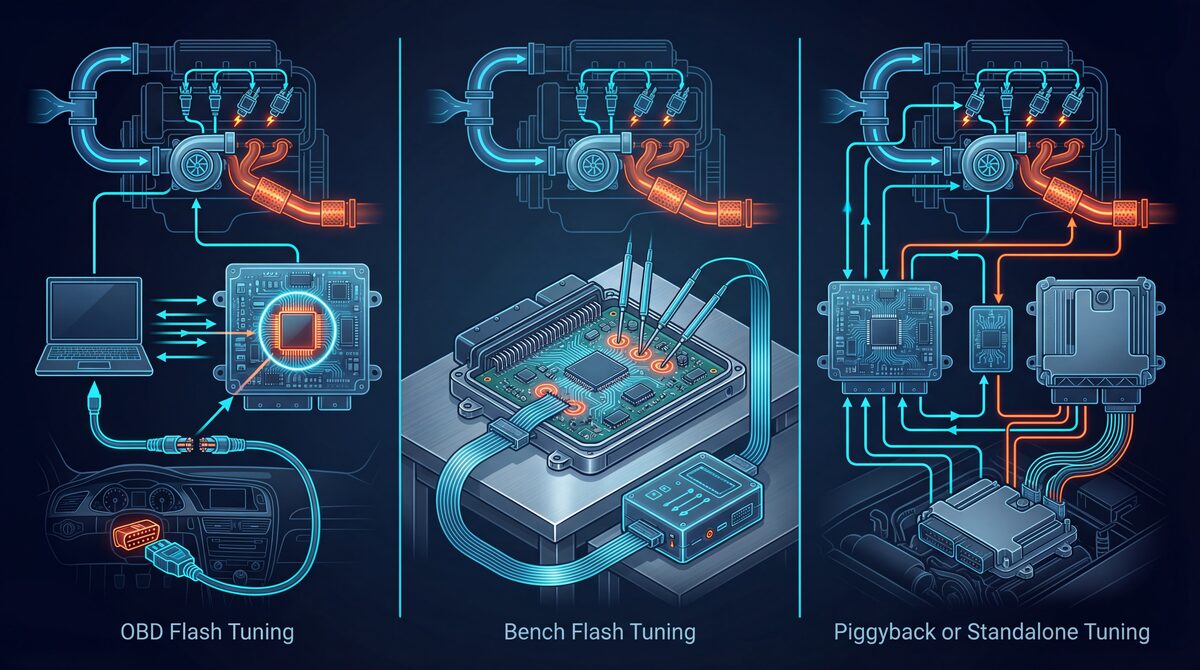
HOW ECU TUNING WORKS
Flash Tuning
The most common form of VW/Audi tuning. A laptop connects to the OBD-II diagnostic port, reads the stock ECU calibration (the collection of maps and parameters that control engine behavior), and uploads a modified calibration. The modified tune changes hundreds of parameters, but the critical ones are:
- Boost target maps: RPM × throttle position → target boost pressure. Stock MK7 GTI targets ~18 psi peak; a Stage 1 tune might target ~24 psi. Big turbo tunes can target 30-40+ psi.
- Ignition timing maps: RPM × load → degrees of spark advance before TDC. More advance = more power, but also more detonation risk. A good tune finds the maximum safe timing for the fuel octane and engine condition.
- Fueling maps: Lambda (air/fuel ratio) targets and injector pulse width corrections. The tune adjusts how much fuel is delivered at every operating point.
- Cam timing maps: Variable valve timing (VVT) and Audi Valvelift System (AVS) targets for variable intake duration/lift.
- Torque limiter removal: VW/Audi ECUs have aggressive torque limiters that cap power output well below hardware capability. Removing these is responsible for a significant chunk of "tune" gains.
- Speed limiter and rev limiter adjustment: Stock limiters removed or raised to match the build.
Piggyback Modules
Piggyback devices intercept sensor signals between the sensor and the ECU, modifying the data to trick the ECU into changing its behavior. The JB4 is the most popular in the VW world — it intercepts the MAP (manifold absolute pressure) sensor and boost pressure sensor signals, causing the ECU to see lower boost than actual, which prevents the ECU from activating boost cut. The COBB Accessport takes a different approach — it's a dedicated flash tuning platform with user-adjustable maps.
Piggyback pros: easily removable (no trace on ECU), can be used with stock warranty coverage, some offer real-time adjustment. Piggyback cons: limited control (can only modify intercepted signals), can't adjust timing, fueling, or cam timing independently, and the ECU's knock detection and safety systems may conflict with modified boost signals.
Standalone ECU
A standalone ECU completely replaces the factory unit with a dedicated engine management system. Brands like Haltech Elite, MoTeC, FuelTech, Link, and MegaSquirt provide complete control over every engine parameter — ignition timing, fuel delivery, boost control, variable cam timing, and more — with no factory limitations.
Standalone is required when: the factory ECU is locked and can't be flash tuned (some newer platforms), running non-standard sensors or actuators, the build has gone so far beyond stock that the factory ECU's parameter ranges are insufficient, or you need features like multi-stage boost control, launch control, anti-lag, traction control, or custom data logging. Most VW builds under 700 WHP work fine with flash tunes; standalone becomes necessary for dedicated race builds above that level.
BOOST CONTROL IN DEPTH
N75 Solenoid (EA113, EA888 Gen1/Gen2)
The N75 is a duty-cycle controlled solenoid valve in the boost reference line between the compressor and the wastegate actuator. At 0% duty cycle, full boost pressure reaches the wastegate actuator and it opens at the actuator's spring pressure (typically 7-10 psi). As duty cycle increases, the N75 bleeds pressure from the line, reducing the signal to the actuator — the wastegate stays closed longer, and boost rises above the spring pressure.
The ECU modulates N75 duty cycle hundreds of times per second based on the boost target map, actual boost, throttle position, engine speed, and knock sensor feedback. This creates a closed-loop boost control system that's precise, responsive, and self-correcting.
Electronic Wastegate Actuator (EA888 Gen3+)
Starting with the EA888 Gen3, VW replaced the N75 solenoid and pneumatic actuator with a motorized electronic wastegate actuator. A small DC motor with a position sensor directly controls the wastegate flap — no boost reference lines, no solenoid, no spring pressure to work against. The ECU commands a specific wastegate position based on the boost target map, and the actuator moves to that position with closed-loop position feedback.
This system is more precise than the N75 (position control vs. pressure control), faster responding, and eliminates the pneumatic components that wear over time. For tuners, it means the boost control strategy is entirely in the ECU calibration — there's no mechanical spring to limit low-RPM boost authority.
Boost Creep
Boost creep occurs when exhaust energy exceeds the wastegate's ability to bypass enough exhaust gas. The wastegate is fully open, but the turbo keeps making more boost because there's still too much exhaust hitting the turbine wheel. This is common on builds where the turbo has been upgraded but the wastegate hasn't — the stock internal wastegate port is simply too small for the exhaust volume.
Solutions: larger internal wastegate (some manifolds offer this), external wastegate (larger flow capacity), or a smaller A/R turbine housing (reduces the exhaust energy reaching the turbine at high RPM). Boost creep is dangerous because the ECU's boost control is saturated — it can't reduce boost no matter what it does with the wastegate.
KNOCK DETECTION AND MANAGEMENT
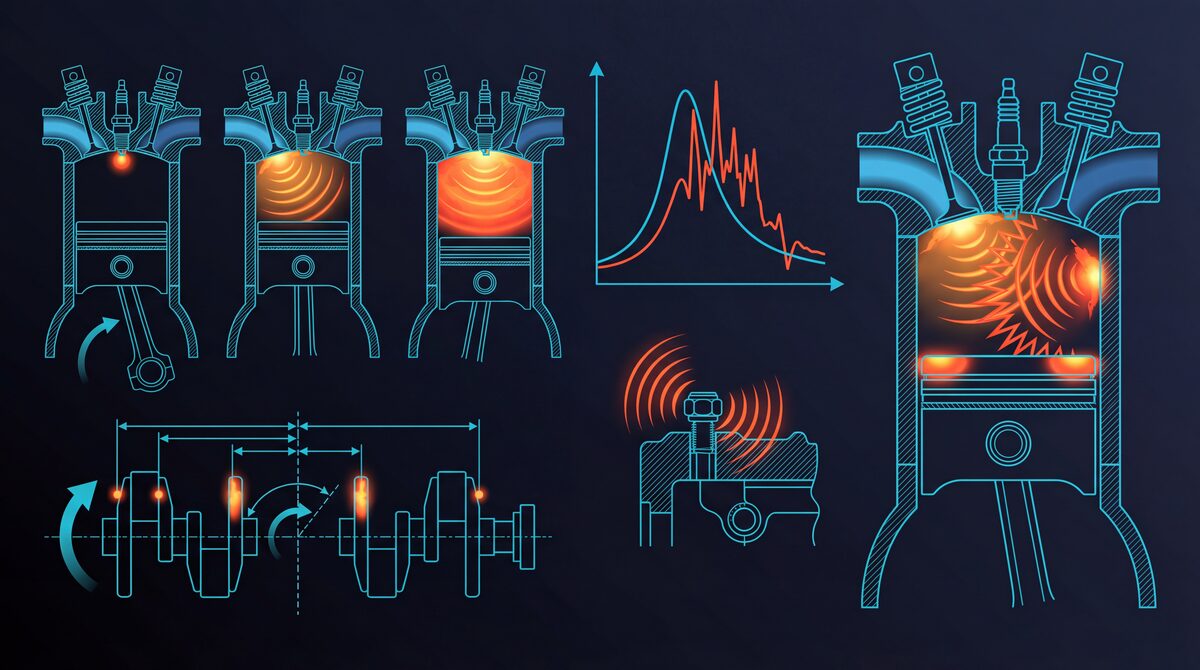
Knock (detonation) is the spontaneous, uncontrolled ignition of the air/fuel mixture before or after the spark plug fires. It produces a characteristic "pinging" sound and generates enormous pressure spikes that can destroy pistons, rings, and bearings in seconds.
VW/Audi engines use piezoelectric knock sensors bolted to the engine block. These sensors detect the high-frequency vibrations (typically 6-8 kHz on VW 4-cylinders) characteristic of detonation. When the ECU detects knock, it pulls ignition timing — reducing spark advance by 1-6 degrees depending on severity. Each degree of timing retard costs approximately 2-3% of peak power.
Consistent knock on a datalog means one of several things: fuel octane is too low for the boost level, charge temperatures are too high (intercooler inadequate), ignition timing is too aggressive for conditions, or there's a mechanical issue (hot spot, carbon buildup, incorrect spark plug heat range). The ECU's knock response is a safety net, not a tuning strategy — if your car is consistently pulling timing, fix the root cause rather than relying on the ECU to save it.
E85 AND FLEX FUEL
E85 (85% ethanol, 15% gasoline) has an effective octane rating of approximately 105, compared to 91-93 for premium pump gas. This dramatically higher detonation resistance allows tuners to run more boost, more ignition timing advance, or both — resulting in significant power gains with the same turbo hardware.
Real-world example on an EA888 Gen3 with the stock IS20 turbo:
- 93 octane tune: ~310 WHP — limited by knock at high boost/timing
- E85 tune: ~395 WHP — more boost and timing, turbo is now the airflow limit
That's a 27% power increase from fuel alone, on the same hardware. The catch: E85 requires approximately 30% more fuel volume per mile, which means worse fuel economy and the need for fuel system upgrades at higher power levels. Ethanol content also varies — the EPA specification for E85 allows anywhere from 51% to 83% ethanol by volume. A flex-fuel tune uses an inline ethanol content sensor to measure the actual ethanol percentage in real-time and adjusts the boost, timing, and fuel maps automatically. This lets you run any blend from pure gasoline to full E85 seamlessly.
POPULAR VW/AUDI TUNING COMPANIES
| Company | Platform Strength | Known For |
|---|---|---|
| APR (Austin, TX) | All VW/Audi | Largest dealer network, ECU + TCU, conservative calibrations. Stage 1-3 + hardware kits. |
| Integrated Engineering (Salt Lake City, UT) | EA888, EA113 | Dyno-verified numbers, full parts catalog. ECU tunes + intake/exhaust/turbo kits. |
| Unitronic (Montreal, CAN) | EA888, DSG/DQ | Strong DSG calibrations, solved MK8 TCU lock. ECU + TCU + hardware. |
| EQT / Equilibrium Tuning | EA888 Gen3/4 | Aggressive calibrations popular with enthusiasts. COBB Accessport-based platform. |
| 034 Motorsport (Fremont, CA) | Audi B-platform | Audi specialist. Dynamic+ software. Longitudinal platform focus (B8/B9 S4/S5, RS3). |
| COBB Tuning | EA888 | Accessport platform with user-adjustable maps. Off-the-shelf (OTS) and pro-tune support. |
| RacingLine (UK) | All VW/Audi | VW Racing heritage. ECU + TCU tunes plus full intake/exhaust/brake parts catalog. |
Will a tune void my warranty?
Under the Magnuson-Moss Warranty Act, a dealer cannot void your entire warranty simply because you installed an aftermarket tune. However, they CAN deny warranty claims for specific components that the modification demonstrably caused to fail. In practice: if your tune causes a turbo failure, the turbo claim can be denied. If your window regulator fails, the tune is irrelevant and the warranty should cover it. Some tuning companies (APR, Unitronic) offer their own powertrain warranties that supplement or replace the factory coverage. Modern VW/Audi ECUs log tuning activity in TD1 flags that dealers can detect — returning to stock doesn't erase these flags.
What's the difference between Stage 1, Stage 2, and Stage 3?
There's no universal standard, but the VW/Audi community generally follows this convention: Stage 1 = ECU tune only, no hardware changes required (stock turbo, stock exhaust). Stage 2 = ECU tune + downpipe (usually catless or high-flow cat) + sometimes intake. Stage 3 = upgraded turbo (IS38 swap, hybrid, or big turbo kit) + supporting fuel and exhaust modifications. Beyond Stage 3, most tuners just describe the build by turbo size rather than "stage" numbers. Note: these stages vary by tuner — always check the specific requirements for your tuning company's calibration.
Do I need a standalone ECU for my build?
For most VW/Audi builds under 700 WHP — no. Flash tuning from reputable companies like APR, IE, Unitronic, or EQT provides excellent calibrations that extract maximum performance from the factory ECU's capabilities. Standalone ECU becomes necessary when: you've exceeded the factory ECU's parameter ranges (extreme boost, non-standard sensors), the factory ECU is locked (some newer platforms), or you need features like anti-lag, multi-stage launch control, or advanced traction control for racing. Standalone adds significant complexity and cost ($2,000-$5,000+ for the unit, plus professional tuning time). Unless your build specifically requires it, stick with flash tuning.
What is knock and why is it dangerous?
Knock (detonation) is the uncontrolled ignition of the air/fuel mixture in the cylinder, separate from the spark plug's controlled ignition. It creates a secondary flame front that collides with the primary one, generating extreme pressure spikes (up to 10x normal combustion pressure) and temperatures. These spikes can crack piston ring lands, erode piston crowns, damage bearings, and crack cylinder heads — in seconds, not hours. The ECU detects knock via vibration sensors and retards timing to protect the engine, but this is a safety net, not a solution. If your datalogs show consistent knock events, the underlying cause (low octane, high charge temps, aggressive timing, carbon deposits) must be addressed.
EXHAUST: DOWNPIPE & BEYOND
The exhaust system on a turbo car serves double duty — it feeds the turbine with exhaust energy and then must get out of the way as quickly as possible. Every restriction after the turbo costs you power by creating backpressure that works against the exhaust stroke.
COLLAPSE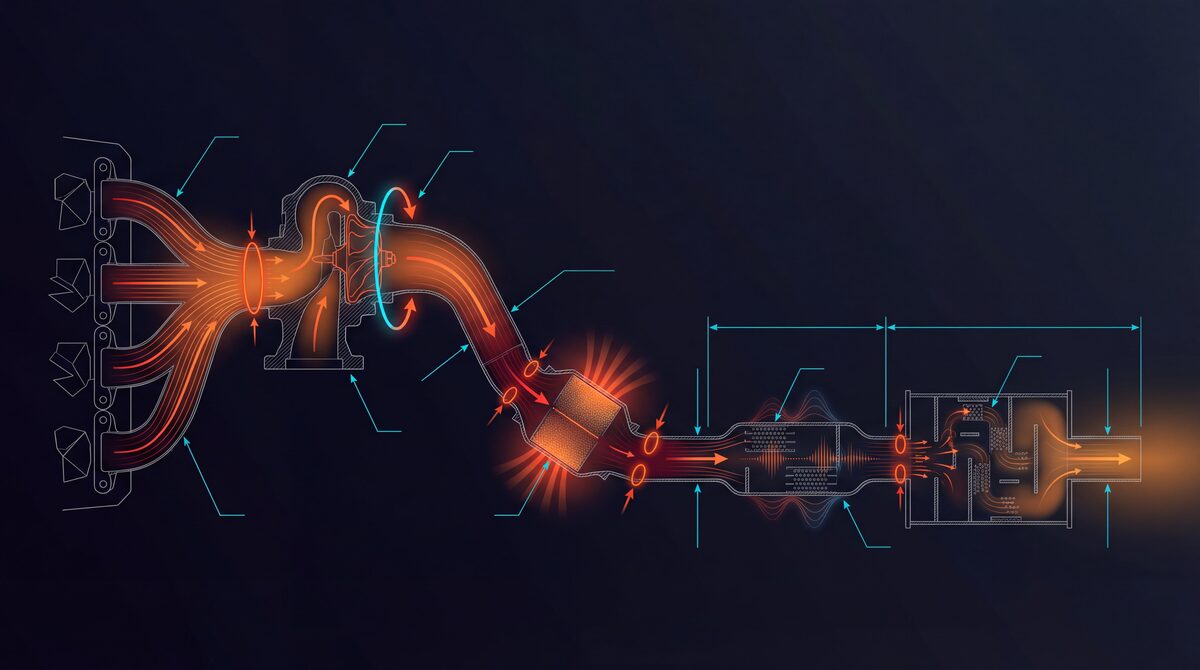
THE DOWNPIPE: WHERE POWER LIVES
The downpipe is the section of exhaust directly after the turbo's turbine housing outlet, and it contains the catalytic converter(s). On modern VW/Audi cars like the MK7/MK8 GTI, the stock downpipe is 2.5" (63mm) diameter with two catalytic converters in series — a close-coupled cat (immediately after the turbo) and an underbody cat. This is the single biggest restriction in the exhaust system.
Replacing the stock downpipe with a larger-diameter unit is the defining hardware modification for Stage 2 tunes, typically yielding 15-25 WHP. The gains come from reduced backpressure, which allows the turbine to spin more freely and the engine to exhaust more efficiently.
Catted vs Catless
| Type | Cell Count | Flow | Power | Considerations |
|---|---|---|---|---|
| Catless | None | Maximum | 100% of potential | Fails emissions, strong smell, off-road/track only |
| High-flow cat | 200-cell metallic | ~95% of catless | 95-98% of catless | Passes most visual inspections, reduced smell |
| Stock cat | 600-cell ceramic | Most restrictive | Baseline | Meets all emissions, no smell |
Legal note: removing or modifying catalytic converters is illegal for street use under federal EPA regulations in the United States. The information in this section is provided for off-road and competition use only.
Downpipe Sizing
- 3" (76mm): The standard upgrade size for VW 4-cylinder turbo applications. Adequate to approximately 500 WHP. This is the right choice for 90% of builds.
- 3.5" (89mm): Diminishing returns on a 4-cylinder, but appropriate for VR6T and 2.5 TFSI builds above 600 WHP where exhaust volume is significantly higher.
- 4" (102mm): Reserved for 800+ WHP builds. At this diameter, the exhaust gas velocity drops so low that scavenging effect is lost — bigger is not always better.
EXHAUST MANIFOLD
The exhaust manifold collects exhaust from each cylinder and directs it to the turbo's turbine housing. The manifold design affects spool characteristics, exhaust gas temperature, and packaging.
Log Manifold
A simple cast or fabricated tube that collects all exhaust runners into one short collector with a turbo flange. Compact, affordable, and fits easily in VW engine bays. The downside: minimal pulse separation between cylinders, which slightly reduces turbine efficiency at low RPM. For most street builds, a quality log manifold works perfectly.
Tubular Equal-Length
Individual runners from each exhaust port, fabricated to equal length, merging at a collector with the turbo flange. Better exhaust pulse separation means smoother spool-up and marginally improved turbine efficiency. More expensive and more difficult to package in a transverse VW engine bay. Best suited for dedicated track and race builds where every detail matters.
Integrated Exhaust Manifold (IEM)
The EA888 Gen3 and later engines cast the exhaust manifold directly into the cylinder head — the turbo bolts to a flange on the head itself with no separate manifold. This design provides the shortest possible exhaust path (faster spool), water-jacketed exhaust passages (lower underhood temperatures), and eliminates the manifold gasket as a failure point. The trade-off: if the integrated manifold cracks, you're replacing the entire cylinder head.
CAT-BACK EXHAUST
Everything after the catalytic converter — mid-pipe, resonator, muffler, tailpipe. On a turbocharged car, cat-back power gains are minimal (5-10 WHP at most) because the turbo itself acts as a very effective muffler, damping exhaust pulses before they reach the cat-back. The primary benefits of a cat-back upgrade are sound, weight reduction, and aesthetics.
- Resonator delete: Louder exhaust, but often adds drone — a low-frequency resonance in the cabin at highway cruise RPM that many people find intolerable.
- Valved exhaust: Electronically controlled valve that bypasses the muffler when opened. Quiet in comfort mode, loud in sport mode. Popular on MK7/MK8 from AWE, Borla, and Remus. This is the best solution if you want adjustable volume without sacrificing daily drivability.
Will a catless downpipe throw a check engine light?
Yes — removing the catalytic converter triggers a P0420 (catalyst efficiency below threshold) code because the downstream O2 sensor sees raw exhaust instead of cleaned exhaust. Most ECU tunes include a "CEL fix" that either disables the rear O2 sensor monitoring or adjusts the parameters so the code doesn't trigger. If you're running a tune, ask your tuner if their calibration includes P0420 suppression. Without a tune, you'll have a permanent check engine light.
Does exhaust size affect turbo spool?
Yes, but less than you'd expect. A larger exhaust reduces backpressure, which means less energy hitting the turbine at low RPM, which can marginally slow spool-up. In practice, going from a 2.5" stock downpipe to a 3" aftermarket downpipe has negligible spool impact on most VW 4-cylinders — the turbo still reaches full boost within 200-300 RPM of the stock setup. The power gains from reduced backpressure at mid and high RPM far outweigh any measurable spool difference.
INTAKE & CHARGE PIPING
The intake side of a turbo system is often overlooked — but every PSI of pressure drop before the compressor makes the turbo work harder, run hotter, and spool slower. Understanding the complete air path from filter to cylinder is key to maximizing your turbo's potential.
COLLAPSE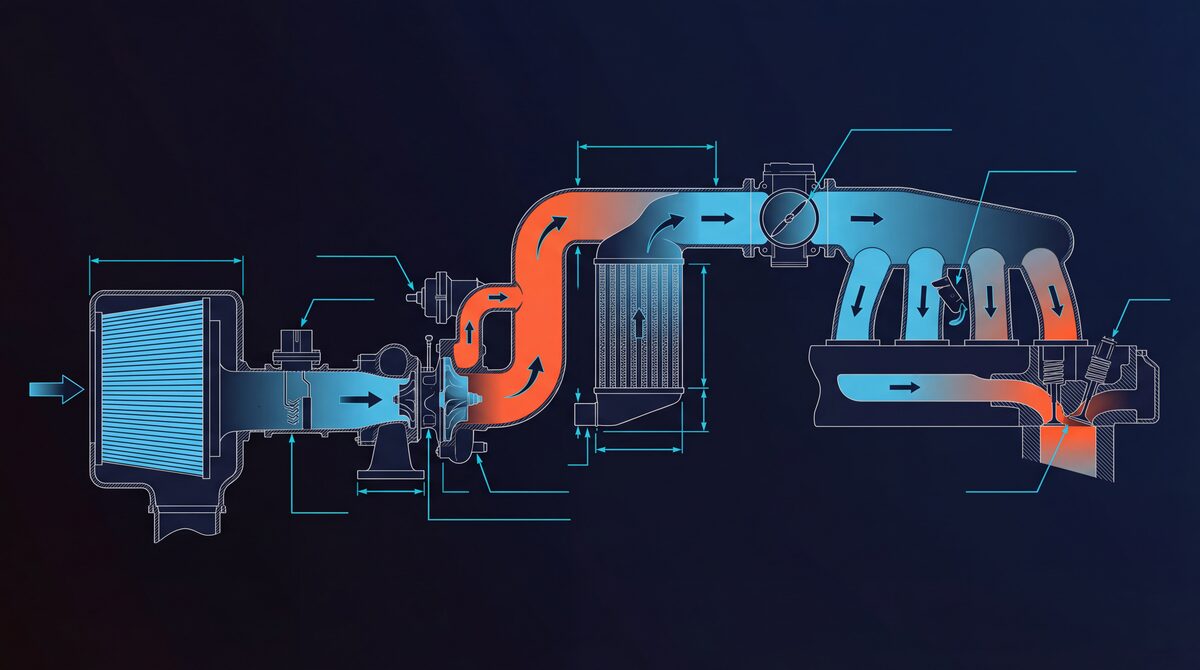
The air path on a turbocharged VW/Audi consists of two distinct sections: the pre-turbo intake (filter to compressor inlet, at sub-atmospheric pressure) and the post-turbo charge path (compressor outlet to intake manifold, at above-atmospheric pressure). Each section has its own components, restrictions, and upgrade priorities.
PRE-TURBO: AIR FILTER TO COMPRESSOR
Turbo Inlet Pipe (TIP)
The turbo inlet pipe connects the air filter/MAF sensor to the compressor inlet. On the EA888 Gen3, the stock TIP is an accordion-style silicone hose that can collapse under high vacuum (when the compressor is pulling hard). This is often the most overlooked restriction in the entire system — upgrading the TIP to a rigid aluminum or reinforced silicone unit from IE, CTS, or ECS can yield 5-15 WHP simply by eliminating collapse and reducing inlet restriction.
Cold Air Intake (CAI)
On a turbocharged car, the intake air gets compressed by the turbo and then cooled by the intercooler regardless of its starting temperature. This means a cold air intake has less impact on charge air temperature than on a naturally aspirated car. The real benefits of a CAI on a turbo VW are:
- Reduced filter restriction: Less pressure drop before the turbo means the compressor works less hard to pull air, improving efficiency and reducing compressor outlet temperature.
- Increased turbo inlet volume: A larger intake pipe gives the compressor a bigger "bite" of air, marginally improving transient response.
- Sound: This is the honest reason most people buy them. An open-element filter lets you hear the turbo spool, the compressor surge, and the blow-off/diverter valve. It's the best bang-for-buck modification in terms of driving experience.
The most effective intake upgrade isn't an open cone filter — it's an enclosed airbox with a larger filter element and a sealed path to cool ambient air. Heat soak from the engine bay is real even on turbo cars, because hotter inlet air reduces compressor efficiency and increases compressor outlet temperature (which the intercooler then has to work harder to cool).
POST-TURBO: CHARGE PIPING
Charge Pipes
The stock charge pipes on the MK7 GTI are plastic with crimped connections to the intercooler end tanks. These are notorious for blowing off under high boost — the crimped connection can't handle the pressure of an aggressive Stage 2 or IS38 tune. Upgraded aluminum charge pipes with silicone couplers and T-bolt clamps are mandatory for any build above Stage 1.
| Power Level | Charge Pipe Size | Notes |
|---|---|---|
| Stock - 300 WHP | 2.0" (stock) | Adequate for Stage 1, but plastic connection is fragile |
| 300 - 400 WHP | 2.5" | Standard upgrade with most FMIC kits |
| 400 - 600 WHP | 2.75" - 3.0" | Recommended for IS38 and big turbo builds |
Blow-Off Valve (BOV) vs Diverter Valve (DV)
When you lift the throttle under boost, the throttle plate closes but the turbo is still spinning — compressed air slams into the closed throttle body with nowhere to go. Without a relief valve, this pressure wave reverses through the compressor (compressor surge), which stresses the compressor wheel bearings and dramatically slows the turbo down.
- Blow-off valve (BOV): Vents the excess charge pressure to atmosphere. Makes the iconic "psshh" sound. Simple and effective.
- Diverter valve (DV) / Recirculating: Routes excess pressure back into the intake, upstream of the turbo. Quieter, and critically important on MAF-based cars — the MAF sensor already measured that air, so venting it to atmosphere creates a rich condition (ECU thinks more air entered than actually reached the cylinders).
VW uses recirculating diverter valves from the factory on all turbocharged models. On MAF-based cars (most VW/Audi street cars), switching to an atmospheric BOV without a tune correction will cause rich running between gear shifts. On MAP-based cars (standalone ECU or some custom tune configurations), atmospheric BOVs work fine because the ECU measures actual manifold pressure rather than incoming airflow.
INTAKE MANIFOLD
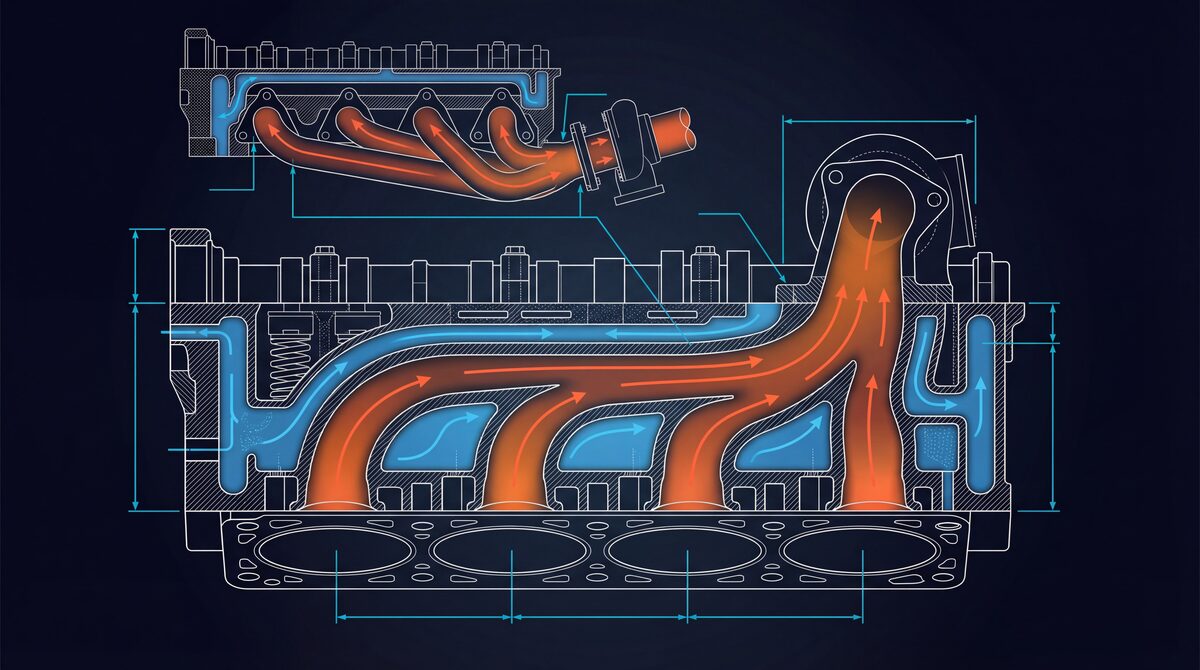
The stock MK7 GTI intake manifold includes integrated tumble flaps that close at low RPM to improve air swirl for better combustion and emissions. At high RPM, these flaps open for maximum flow. Aftermarket intake manifolds from Integrated Engineering remove the tumble flaps entirely, increase runner diameter, and enlarge the plenum volume.
The trade-offs with aftermarket manifolds:
- Larger plenum volume: Acts as an air reserve — helps maintain steady boost pressure during rapid throttle changes. Slight reduction in immediate throttle response (more volume to pressurize).
- Shorter runners: Favor high RPM power (above 5,000 RPM) at the expense of low-RPM torque. The tuned-length resonance effect shifts upward.
- No tumble flaps: Eliminates a common failure point (flap screws backing out into the cylinder — a known issue on some EA888 variants) but may slightly worsen cold-start emissions and low-load combustion quality.
Intake manifold upgrades are only worth considering for builds above 450-500 WHP where the stock manifold's runners and plenum become a measurable restriction. For most street and Stage 2 builds, the stock manifold is adequate.
Should I get an intake or a downpipe first?
Downpipe first — every time. On a turbocharged VW, the downpipe is the single biggest restriction in the exhaust system, and removing it (with a Stage 2 tune) yields 15-25 WHP. An intake on a turbo car yields 5-10 WHP. The downpipe also enables the Stage 2 tune, which changes boost targets and timing — the intake just reduces a minor inlet restriction. If your budget only allows one modification beyond a tune, make it a downpipe.
Do I need to upgrade my charge pipes for Stage 1?
For Stage 1 on a MK7/MK7.5 GTI — technically no, but it's cheap insurance. The stock plastic charge pipes can hold the boost levels of a conservative Stage 1 tune, but they're the weakest link in the charge system. A $150-$200 aluminum charge pipe upgrade eliminates the possibility of a boost leak under load. If you're going Stage 2 or IS38, upgraded charge pipes are mandatory — the stock plastic will blow off.
Atmospheric BOV or recirculating DV — which should I get?
If your car uses a MAF sensor (virtually all stock and lightly modified VW/Audi setups), use a recirculating diverter valve. Venting metered air to atmosphere causes a rich condition between shifts that the ECU has to correct for, leading to hesitation and poor part-throttle behavior. An upgraded recirculating DV (like the GFB DV+) gives faster, more positive venting without the MAF issues. Only use an atmospheric BOV if you're running a MAP-only ECU strategy (standalone, or some custom tunes that disable the MAF) where vented air doesn't affect fueling calculations.
PREPARING THE ENGINE
Beyond a certain power threshold, the turbo system stops being the limiting factor — the engine's internals become the weakest link. This chapter covers what fails, why, and what to replace before it breaks.
COLLAPSECompression Ratio: The Balancing Act
Compression ratio is the ratio of cylinder volume at bottom dead center (BDC) to top dead center (TDC) — total swept volume plus combustion chamber volume, divided by combustion chamber volume alone. On a naturally aspirated engine, higher compression means more thermal efficiency and more power. On a turbocharged engine, the equation changes: the turbocharger is already compressing the charge air before it enters the cylinder, so higher static compression plus boost pressure creates exponentially higher peak cylinder pressures.
This is why detonation is the primary enemy of turbocharged engines. When cylinder pressure and temperature exceed the fuel's auto-ignition threshold, the unburned mixture ignites spontaneously before the spark plug fires. This creates a shockwave that hammers the piston crown, ring lands, and rod bearings. On a cast piston, a single sustained detonation event can shatter a ring land in seconds.
| Application | Compression Ratio Sweet Spot | Why |
|---|---|---|
| Pump Gas (91-93 Octane) | 8.5:1 – 9.5:1 | Limits detonation risk at moderate boost |
| E85 (Ethanol) | 9.0:1 – 10.0:1 | E85's ~105 effective octane allows higher CR |
| Race Gas / Methanol | 10.0:1 – 11.0:1 | Maximum thermal efficiency with detonation-resistant fuel |
Stock VW compression ratios vary: the EA113 1.8T runs 9.5:1 across all variants (AWP, AWW, BAM, AMU) — some early AEB/ATW engines were 9.0:1. The EA888 Gen3 in GTI guise is 9.6:1, while the Golf R variant runs 9.3:1 (lower to accommodate higher factory boost). These stock ratios are designed for pump gas at factory boost levels. Push beyond Stage 2 boost on pump gas and you're living on the edge of what the stock compression will tolerate.
Methods to reduce compression ratio: dished pistons (the most common — the piston crown has a concave dish that increases combustion chamber volume), thicker head gaskets (adds volume between the deck and head), and machining valve reliefs into the piston crown. Lower compression isn't free — every point of compression you remove reduces thermal efficiency, meaning you make less power per PSI of boost. The goal is to find the lowest compression that keeps you out of detonation at your target boost and fuel, and no lower.
Head Gaskets Under Boost
The stock head gasket on most modern VW turbo engines is MLS (Multi-Layer Steel) — typically 3-5 layers of stainless steel with an elastomer coating between layers. MLS gaskets seal through the spring-loading effect of the steel layers compressing against each other, combined with the clamping force of the head bolts.
Under high boost, cylinder pressure tries to lift the head off the block on every combustion event. At 30+ PSI of boost, peak cylinder pressures can exceed 1,500 PSI — multiplied across the 82.5mm bore area of an EA888 cylinder, that's over 6 tons of force pushing the head away from the block on every power stroke. When that force exceeds the clamping force of the head fasteners, combustion gases blow past the gasket.
Head gasket failure symptoms: coolant mixing with oil (milky residue on the oil cap or dipstick), oil in the coolant reservoir, white sweet-smelling exhaust smoke (coolant burning), pressurized coolant system that pushes coolant out the overflow, and intermittent misfires under boost that clear at idle.
Head Studs vs. Head Bolts
This is the single most impactful upgrade for head gasket sealing, and it comes down to physics. A head bolt threads into the block and is tightened by rotating the bolt head. The friction between the bolt shank and the threads consumes 30-50% of the applied torque — so the actual clamping force varies ±25% from bolt to bolt. You could torque every bolt to spec and have wildly uneven clamping across the head.
A head stud is a separate operation: the stud threads into the block first (no rotation-induced stress), then a nut is torqued onto the top. Because the stud isn't twisting, all the torque converts to pure axial stretch — clamping force is predictable to ±5%. More uniform clamping means the head gasket sees even pressure all the way around, which is exactly what you need at 30+ PSI.
| ARP Stud Kit | Material | Tensile Strength | Application |
|---|---|---|---|
| ARP 2000 | 8740 Chromoly | 220,000 PSI | Most builds up to ~700 WHP |
| ARP Custom Age 625+ | Nickel Alloy | 260,000 PSI | Extreme builds, 800+ WHP |
| ARP L19 | High-Alloy Steel | 280,000 PSI | Pro-level, requires careful maintenance |
Connecting Rods: Where the Money Is
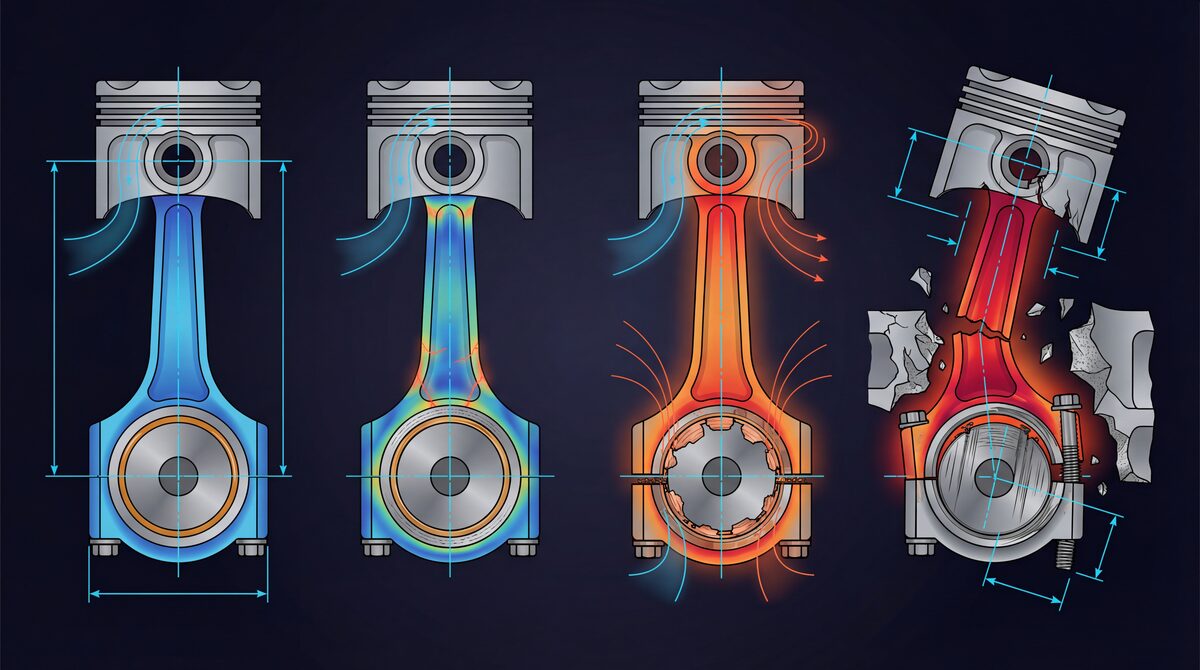
The connecting rod's job is simple: convert the piston's linear motion into the crankshaft's rotary motion. Under boost, it does this while absorbing enormous compressive loads on the power stroke (the combustion event pushing the piston down) and tensile loads at TDC on the exhaust stroke (inertia trying to pull the piston out of the bore). The tensile load at high RPM is what kills rods — the rod bolt stretches, the rod cap separates, and the rod goes through the side of the block.
| Engine | Stock Rod Type | Failure Threshold (WHP) |
|---|---|---|
| EA113 1.8T | Sintered Powder Metal | 350-400 WHP |
| EA888 Gen3 | Fractured Forged Steel | ~500 WHP |
| EA855 2.5 TFSI | Forged | ~500 WHP |
| VR6 12V | Cast | ~400 WHP |
| VR6 24V | Cast | ~350 WHP |
Aftermarket connecting rods come in two main profiles: H-beam and I-beam. H-beam rods (from manufacturers like IE, Manley, Carrillo, and Pauter) have a wide, flat beam with an H-shaped cross-section — they're stronger at high RPM under tensile loads, which is exactly where boost puts the most stress. I-beam rods are lighter and better for high-RPM naturally aspirated applications where reciprocating mass matters more than raw strength. For turbo VW builds, H-beam rods with ARP2000 rod bolts are the standard — good to 800-1200+ WHP depending on the specific rod and bolt combination.
Forged Pistons: Cast vs. Forged
Stock pistons on most VW engines are cast — molten aluminum poured into a mold. Cast pistons are dimensionally precise, thermally stable, and perfectly adequate at stock power. Their failure mode is the problem: cast aluminum is brittle. Under detonation or excessive thermal stress, a cast piston doesn't bend — it shatters. Ring lands crack, piston skirts fracture, and chunks of aluminum drop into the crankcase.
Forged pistons (JE, Wiseco, Mahle, CP-Carrillo) are machined from a billet of aluminum that's been compressed under thousands of tons of pressure. The grain structure is denser, stronger, and more ductile — a forged piston will deform under extreme stress rather than shatter. This gives you time to notice a problem (detonation, lean condition) and shut down before catastrophic failure.
| Alloy | Characteristics | Best For |
|---|---|---|
| 2618 Aluminum | Softer, higher thermal expansion, more forgiving | Race builds, high-boost applications |
| 4032 Aluminum | Harder, tighter piston-to-wall clearance, quieter cold start | Street builds, daily drivers |
Piston-to-wall clearance is larger on turbo builds: 0.003"-0.005" typical for turbo versus 0.001" for naturally aspirated. The larger clearance accounts for greater thermal expansion under boost — a too-tight piston in a turbo application will expand into the cylinder wall under load, scoring the bore and seizing the piston. The tradeoff is a slight rattle on cold start (piston slap) until the engine reaches operating temperature and the aluminum expands to fill the clearance.
Piston Ring End Gap
This is a detail that separates professional builds from amateur ones. The piston ring is a split ring — there's a gap where the two ends don't quite meet. Under heat, the ring expands. On a turbo engine running 25+ PSI of boost, cylinder temperatures are significantly higher than stock, and the rings expand more than the factory gap accounts for.
If the gap is too tight, the ring ends butt together under thermal expansion, which has exactly one outcome: the ring locks in the bore, scores the cylinder wall, and seizes the piston. Game over. If the gap is too large, you get excessive blow-by — combustion gases leaking past the rings into the crankcase, reducing power and contaminating the oil.
| Ring Position | Turbo Gap (per inch of bore) | Example: 82.5mm Bore (3.248") |
|---|---|---|
| Top Ring | 0.004" – 0.005" | 0.013" – 0.016" |
| Second Ring | 0.005" – 0.006" | 0.016" – 0.019" |
| Oil Ring | Per manufacturer spec | Typically pre-gapped |
Camshafts for Turbo Applications
Camshaft selection for turbocharged engines is fundamentally different from naturally aspirated engines. An NA engine wants maximum duration and lift — keep the valves open as long as possible to flow as much air as the engine can pull in by its own vacuum. A turbo engine has a compressor forcing air in, so the priority shifts to managing valve overlap and exhaust flow.
Valve overlap is the period when both the intake and exhaust valves are open simultaneously (at TDC between exhaust and intake strokes). On an NA engine, some overlap helps scavenging — exhaust gas velocity pulls fresh charge into the cylinder. On a turbo engine, too much overlap means boost pressure blows straight through the combustion chamber and out the exhaust — wasted energy. Too little overlap and scavenging suffers, leaving hot residual exhaust gas in the cylinder that promotes detonation.
VW's own solution on the EA888 Gen3 is the AVS (Audi Valvelift System) — a variable exhaust cam profile with two sets of cam lobes per exhaust valve. At low RPM, the smaller lobe is active: shorter duration for better pulse charging and reduced overlap. At high RPM, the ECU switches to the larger lobe: more duration for maximum exhaust flow. This is documented in SSP436 and is one of the Gen3's key advantages over its predecessors.
Aftermarket turbo camshafts (Cat Cams, Schrick, Autotech) typically increase exhaust duration while keeping intake duration and overlap in a moderate range. The result is better exhaust energy delivery to the turbo (faster spool) without the boost-through-exhaust penalty of aggressive overlap.
Balancing the Rotating Assembly
When you replace rods and pistons, the new components won't match the factory balance. Every piston must weigh the same. Every rod must weigh the same (both big end and small end, separately). The crankshaft counterweights must offset the combined mass of each piston-and-rod assembly. The flywheel and clutch are part of this balanced assembly. At 7,000+ RPM, even a few grams of imbalance creates vibration that accelerates bearing wear and can crack the crankshaft over time. Professional balancing on a Hines or Stewart-Warner machine is not optional on a built engine — it's the difference between a motor that lasts 100,000 miles and one that grenades at 30,000.
INTERACTIVE: EFFECTIVE COMPRESSION & DETONATION RISK CALCULATOR
Adjust compression ratio, boost pressure, and fuel type to see if your combination is safe — or if you're risking detonation.
At what power level do I need forged internals?
It depends on the engine. On an EA113 1.8T, the stock sintered rods are the weak point — most builders recommend forged rods and pistons at anything beyond 350 WHP. The EA888 Gen3 has significantly stronger stock internals (fractured forged rods) and can handle up to ~500 WHP on stock rods, though many builders choose to forge the bottom end at 450+ WHP as insurance. The 2.5 TFSI is similarly robust to ~500 WHP on factory internals. Rule of thumb: if you're running a big turbo and the stock internals are the documented failure point for your power target, forge before you break — rebuilding after a rod goes through the block costs three times more than building it right the first time.
Can I run high boost on stock compression with E85?
Yes — E85's high effective octane (~105) is a game-changer. An EA888 Gen3 at 9.6:1 compression on E85 can safely run 28-32 PSI with proper tuning, whereas the same engine on 93 octane would start detonating at 25-26 PSI. Many "big power" GTI and Golf R builds run 400-500+ WHP on stock compression with E85 and forged internals. The tradeoff: E85 requires ~30% more fuel flow (it has lower energy density per gallon), so your fuel system needs to support the extra volume, and you burn through fuel faster. If you have E85 available locally, it's the single best mod-per-dollar for safely making power on stock compression.
Do I really need to balance the rotating assembly?
If you're replacing rods and pistons — yes, absolutely, no exceptions. Aftermarket components don't match the factory balance. A professional balance job costs $300-$500 and takes 2-3 hours on a balancing machine. Skipping it saves you one shop visit and costs you an engine in 20,000 miles. At 7,000 RPM, the reciprocating assembly is cycling 117 times per second — even a 5-gram imbalance at that speed creates destructive harmonic vibration that eats rod bearings and main bearings. Balance everything: pistons (by weight), rods (big end and small end separately), crankshaft with bobweights, flywheel, and clutch as a matched assembly.
CLUTCH & DRIVETRAIN
The engine makes the power. The drivetrain delivers it. And the clutch is the sacrificial link between the two — designed to slip before something more expensive breaks. Upgrade the engine without upgrading the drivetrain, and you'll learn this lesson the expensive way.
COLLAPSEWhy the Clutch Fails First
The stock clutch on every VW turbo car is rated for factory torque — and usually not much beyond it. A Stage 1 ECU tune on a MK7 GTI adds 70-100 lb-ft of torque, which is a 25-35% increase over stock. The clutch disc's friction material simply can't hold that much torque without slipping. Symptoms are unmistakable: you accelerate in 3rd or 4th gear under full throttle, and the RPMs climb faster than the car accelerates. There's often a burning smell — that's the friction material glazing from heat. Once the clutch starts slipping regularly, it deteriorates quickly as the glazed surface loses even more grip.
Clutch Disc Types
| Type | Torque Capacity | Engagement Feel | Best For |
|---|---|---|---|
| Organic (Stock-Type) | Moderate (~300-350 lb-ft) | Smooth, progressive | Stage 1, daily driver |
| Ceramic / Puck | High (~500-600 lb-ft) | Grabby, chattery | Track, drag racing |
| Dual-Disc / Twin-Disc | Very High (~700+ lb-ft) | Moderate (load split) | Big turbo, high-power builds |
Single-Mass vs. Dual-Mass Flywheel
The factory dual-mass flywheel (DMF) has two halves connected by springs — it absorbs torsional vibrations from the crankshaft before they reach the clutch and transmission. This makes the car civilized: no gear rattle at idle, smooth clutch engagement, minimal driveline shudder. The tradeoff: DMFs are heavy (they add rotational inertia, which slows rev changes) and they wear out (the internal springs fatigue, especially under the repeated shock loading of aggressive driving).
A single-mass flywheel (SMF) is a solid disc — lighter, cheaper, and indestructible. It also transmits every vibration straight to the transmission. Gear rattle at idle, more aggressive clutch engagement, and noticeable driveline vibration at low RPM in high gear. Most tuners building beyond Stage 1 go with an SMF paired with an uprated clutch — the reduced rotational mass means the engine revs faster (improving turbo response), and an SMF never needs replacement.
VW-specific tip for the EA113 1.8T: the VR6 clutch (from the MK4 VR6) is a direct bolt-on upgrade. The VR6 clutch has a larger friction area and higher clamping force than the stock 1.8T unit. It's not a massive upgrade, but for a Stage 1 1.8T build, it's a $200 solution that buys you another 50-60 lb-ft of capacity over the stock clutch. Beyond that, purpose-built options from Clutch Masters, South Bend, Sachs Performance, and DKM are required.
DSG / DCT Transmissions
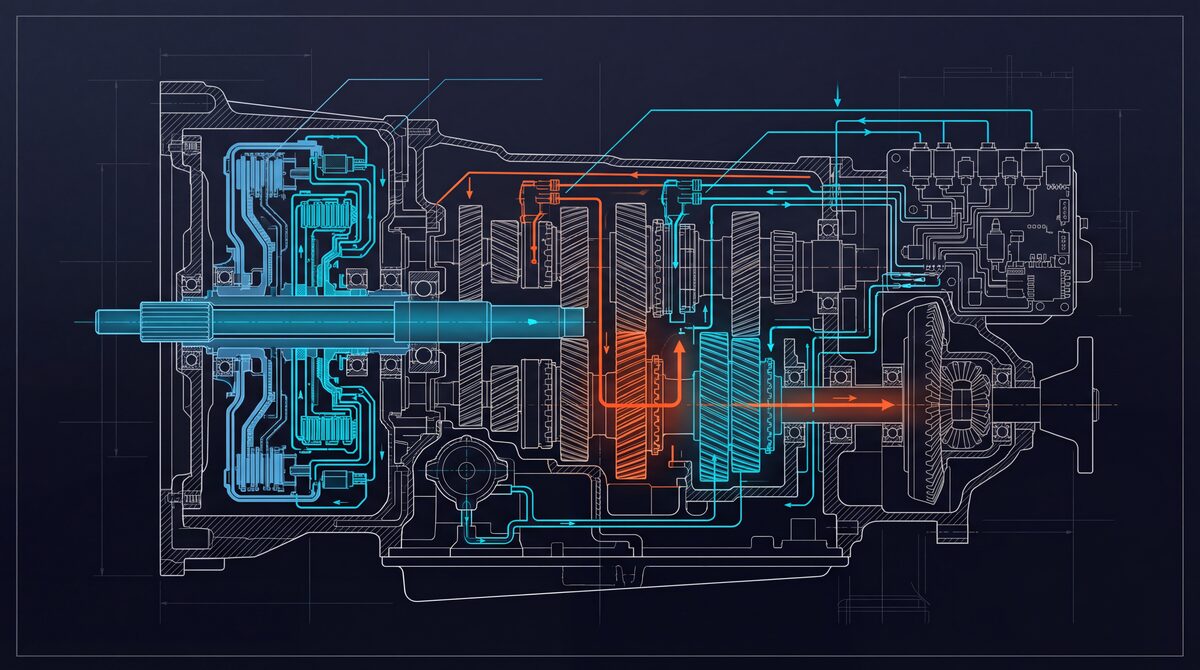
VW's DSG (Direct Shift Gearbox) is a dual-clutch automated manual — two separate clutch packs, two concentric input shafts, and a mechatronic unit (hydraulic valve body + dedicated ECU) that controls everything. While you're in 3rd gear (clutch K1 engaged), the mechatronic unit has already pre-selected 4th gear on the K2 shaft. When you accelerate through the shift point, K1 releases and K2 engages simultaneously — total shift time under 10 milliseconds. It's faster than any human can shift a manual, and under boost, that means zero torque interruption during shifts.
| DSG Variant | Type | Stock Torque Limit | Upgraded Limit | Found In |
|---|---|---|---|---|
| DQ200 | 7-Speed Dry Clutch | 250 Nm | Not tuner-friendly | Base models |
| DQ250 | 6-Speed Wet Clutch | ~400 Nm | ~550 Nm | MK5/6/7 GTI, MK6 R |
| DQ381 | 7-Speed Wet Clutch | ~500 Nm | ~600 Nm | MK7.5 R, MK8 GTI/R |
| DQ500 | 7-Speed Wet Clutch | ~550 Nm | ~700 Nm (clutch), 900+ Nm (clutch + gears) | RS3, TTRS, some Golf R |
The DQ200 (7-speed dry clutch) is found in non-performance VW models and is essentially off-limits for tuning. The dry clutch packs cannot be upgraded meaningfully, and the gearbox internals aren't designed for additional torque. If your VW came with a DQ200, the modification path is a manual swap or engine swap into a different platform.
The DQ250 is the workhorse tuner DSG — found in every MK5/MK6 GTI and R, and the MK7 GTI. Stock clutch packs handle about 400 Nm before slipping. With upgraded clutch packs (DSG Performance, BMP Design, Dodson Motorsport) and a TCU tune that raises torque limits and adjusts clutch clamping pressure, the DQ250 handles 550 Nm reliably. That's enough for a solid IS38 build on pump gas.
The DQ381 in the MK7.5 R and MK8 models is stronger from the factory — 7 speeds in a wet-clutch package with better materials. TCU-tuned, it handles ~600 Nm. There was a notable challenge: the MK8 Golf R's DQ381.2 came with a locked "401 bootloader" that initially prevented TCU tuning. This has since been cracked by Unitronic, TVS, and IE — MK8 R DSG tuning is now fully available.
The DQ500 is the beast — found in the RS3, TTRS, and some market-specific Golf R models. It's VW's strongest dual-clutch unit. With a BAR-TEK specification clutch pack upgrade, it handles 700 Nm. For higher power levels (900-1000+ Nm), you need reinforced clutch packs AND gear reinforcement — the clutch isn't the only limit, the gear teeth and synchros have their own load ceiling.
TCU tuning is as important as ECU tuning on DSG cars. A stock TCU will intervene to protect the clutch packs — it limits torque output, enforces conservative shift points, and triggers "limp mode" if it detects conditions exceeding its programmed limits. A TCU tune raises those limits to match the actual hardware capability, adjusts shift speeds, improves launch control, and removes torque-based speed limiter interventions.
Haldex AWD System
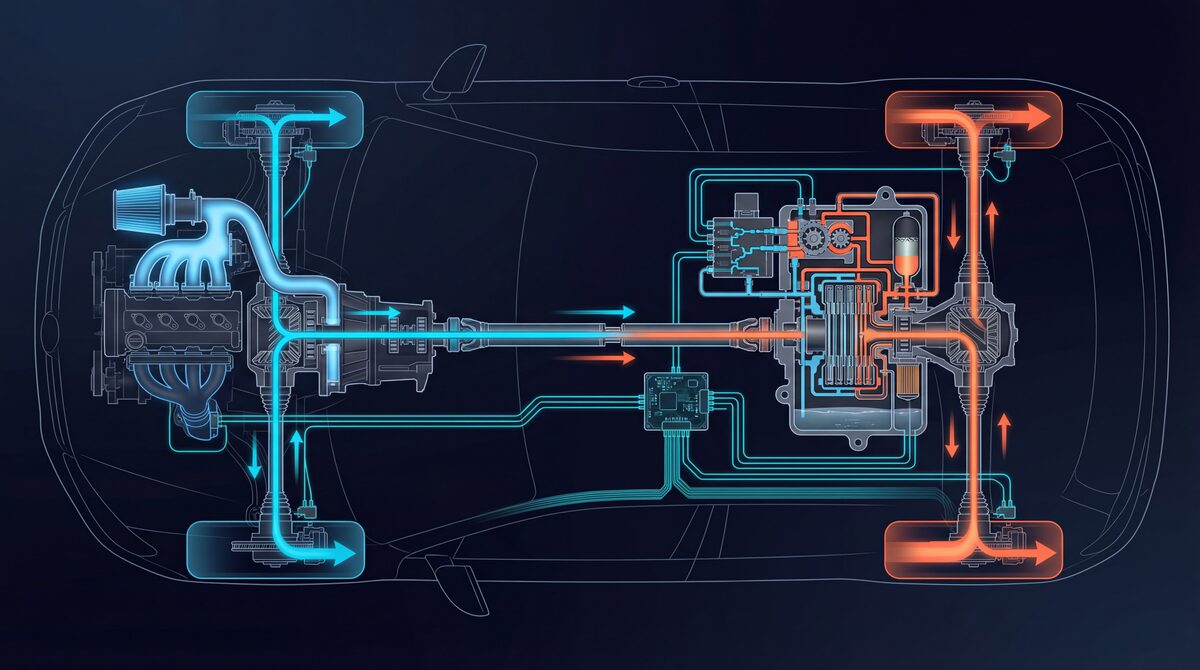
Every transverse-engined VW/Audi AWD vehicle — Golf R, S3, A3 Quattro, TT/TTS, Octavia RS 4x4 — uses the Haldex system. It's fundamentally different from Audi's longitudinal Torsen-based Quattro. Haldex is front-biased: under normal driving, 100% of torque goes to the front wheels. When the front wheels slip, an electrohydraulic multi-plate clutch pack at the rear differential engages and can send up to 50% of torque to the rear axle.
The key word is "reactive" — the Haldex system responds to slip, it doesn't anticipate it. There's always a brief delay between front wheel slip and rear axle engagement. Each generation has improved this response time: the Gen 1 in the MK4 R32 was noticeably delayed, while the Gen 5 in the MK7+ Golf R is nearly imperceptible in normal driving. Controller upgrades from companies like HPA and ShopDAP modify the engagement logic to be more proactive — keeping partial rear engagement even before slip is detected, which gives the car a more rear-biased feel and better corner entry behavior.
Haldex maintenance is non-negotiable: fluid change every 20,000 miles and strainer cleaning every 40,000 miles. The RS3 and TTRS Haldex pumps are particularly prone to clogging from clutch dust — a blocked strainer starves the pump of fluid, which causes delayed engagement and can overheat the clutch pack. This is a $30 maintenance item that prevents a $3,000 Haldex unit replacement.
Axles and CV Joints
The weakest mechanical link in a FWD VW is the axle CV joints. Stock VW axles handle roughly 350-400 HP on a front-wheel-drive car, or 400-500 HP on an AWD car (where the torque is split between front and rear). Beyond those limits, the CV joints reach their angle-under-load capacity — especially the inner CV on the driver's side, which sees the highest torque due to shorter axle length on most transverse-engine cars.
Symptoms of an axle at its limit: clicking during turns under power (the CV joint balls are popping out of their races), vibration under hard acceleration, and eventually a broken axle shaft that leaves you stranded. Upgraded axles from Raxles and The Driveshaft Shop use larger CV joints, thicker shafts, and higher-grade materials — typically rated for 600-800+ HP depending on the application.
Manual or DSG for a turbo build?
For drag racing and consistent launches: DSG. The launch control and instant shifts are unbeatable for repeatable elapsed times. For spirited street driving and track days: personal preference. A manual gives you more driver engagement and a lower-maintenance clutch replacement path — a Stage 2 South Bend clutch is $800 and you replace it yourself. A DSG clutch pack upgrade is $1,500-$2,500 and requires specialized fluid and tools. For extreme power (800+ WHP): manual with a twin-disc clutch, or a DQ500 with full reinforcement. At that power level, the DQ250 and DQ381 are at their absolute limits even with upgrades.
How do I know if my clutch is slipping?
The test is simple: in the highest gear your car has (5th or 6th), at 2,500-3,000 RPM, floor the accelerator. If the RPMs jump up rapidly without a corresponding increase in vehicle speed, the clutch is slipping. You may also smell burning friction material (like burning paper or a hot brake pad smell). On a DSG, slipping manifests as a "flare" — the RPMs momentarily spike above the target during a hard shift, especially WOT upshifts from 2nd to 3rd. The VCDS/OBD Eleven "slip" parameter for each clutch pack shows the exact clutch slip in degrees of rotation.
Is Haldex AWD reliable at high power?
The Haldex unit itself handles power well — the clutch pack and pump can manage 500+ HP without modifications. The limitation is response time and torque split (capped at 50% rear). At high power levels on a Haldex car, you're still asking the front tires to handle at least 50% of the torque on launch, which means the front axles and CV joints are the real limit. A 600 HP Golf R will eat front axles on aggressive launches. Many high-power Haldex builds focus on mid-range power and roll racing rather than standing launches, where the AWD system's gradual engagement works in your favor.
SUPPORTING SYSTEMS
A turbo engine generates more of everything — more heat, more blow-by, more stress on every fluid and seal. The supporting systems are what separate a turbo build that runs for 100,000 miles from one that grenades in 10,000.
COLLAPSEOil System: Temperature Is Everything
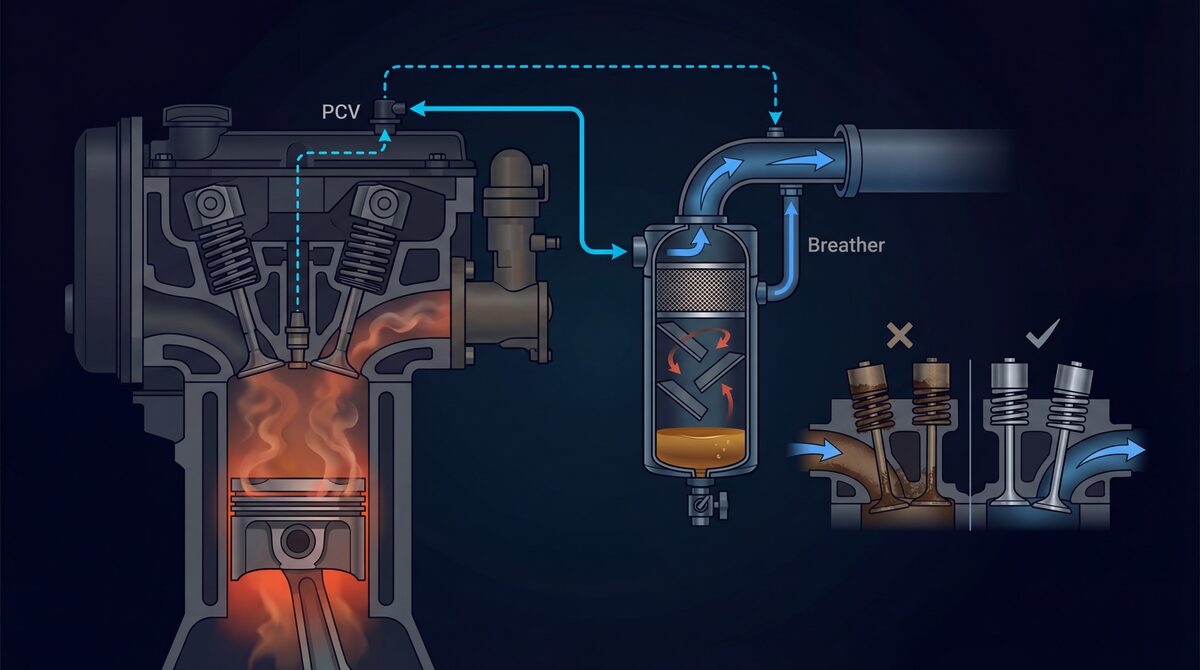
Oil temperature is the single most important gauge on a turbocharged car — more important than boost pressure, more important than coolant temp. Here's why: conventional motor oil begins losing film strength above 260°F. Above 280°F, the oil's viscosity drops to the point where bearing surfaces start making contact. Above 300°F, the oil is cooking — additives break down, the oil oxidizes rapidly, and you're doing cumulative damage to every bearing surface in the engine on every revolution.
Stock VW turbo engines have a water-to-oil heat exchanger bolted to the block — the engine's coolant absorbs heat from the oil. This works fine at stock power because the heat load is manageable. As you increase boost and power, you increase combustion temperatures, which heat the oil more through the piston rings, rod bearings, and turbo bearing housing. A 400 WHP EA888 on a hot day at a track event can see oil temps above 280°F with the stock cooler alone.
The solution is a secondary air-to-oil cooler — an additional oil cooler mounted in the front bumper (like a small radiator, but for oil). It adds significant cooling capacity because it's exposed to ambient airflow. The key is a thermostat on the cooler circuit: without one, the oil will be over-cooled in winter, which is just as bad as overheating. Cold oil is thick oil — it doesn't flow to bearings fast enough on startup and causes accelerated wear. A 180°F thermostat keeps the oil in the optimal 200-240°F operating range regardless of ambient conditions.
Catch Cans and PCV Management
The PCV (Positive Crankcase Ventilation) system evacuates blow-by gases from the crankcase and routes them back into the intake manifold for re-combustion. On every engine, some combustion gas leaks past the piston rings into the crankcase — this is blow-by. It contains unburned fuel vapor, water vapor, and oil mist. The PCV valve opens under intake vacuum and pulls these gases back into the intake system.
The problem on direct-injection engines (every EA888 Gen3, every modern VW turbo) is severe: the blow-by gases carry oil mist, and that oil mist coats the back side of the intake valves. On a port-injected engine, fuel spraying through the intake ports washes the valves clean. On a direct-injection engine, fuel sprays directly into the combustion chamber and never touches the intake valves. Over 40,000-60,000 miles, the oil residue bakes into hard carbon deposits that restrict airflow around the valves, causing misfires, rough idle, and progressive power loss.
VW's factory engineering on this has improved with each generation. SSP436 documents the EA888 Gen3's integrated blow-by duct and cyclone separator in the crankcase — it separates the heaviest oil droplets before they reach the PCV valve. The Audi 4.0 V8 TFSI (documented in SSP607) went further with a three-stage system: coarse oil separator, fine oil separator using an impactor plate, and a pressure control valve — VW's most sophisticated factory crankcase ventilation design.
Aftermarket catch cans (BSH, 034 Motorsport, IE, Mishimoto) install between the PCV valve outlet and the intake manifold. Inside the catch can is a baffled chamber — 3-4 plates that oil-laden air must navigate around. Oil droplets, being heavier than the gas, can't follow the sharp directional changes and collect on the baffle surfaces, draining to a reservoir at the bottom that you empty periodically. The clean air continues to the intake. On a boosted engine, crankcase pressure increases with boost (more blow-by at higher cylinder pressures), so the PCV system works harder and pushes more oil mist — making a catch can even more critical.
Water/Methanol Injection
Water/methanol injection sprays a fine mist of a water-methanol mixture (typically 50/50) into the charge pipe between the intercooler outlet and the throttle body. The effect is twofold: the water evaporating absorbs enormous amounts of heat from the charge air (latent heat of vaporization — the same principle that makes sweat cool your skin), and the methanol acts as a supplemental fuel with an effective octane rating above 110.
The result: intake air temperatures drop 50-100°F below what the intercooler alone achieves, and the effective octane of the fuel-air mixture increases significantly. This allows the ECU to run more aggressive timing without detonation, which translates to 20-40 WHP on an already-tuned car. It's particularly valuable in areas without access to E85 — water/methanol injection bridges the gap between 93 octane pump gas and E85's detonation resistance.
Typical systems (AEM, Snow Performance) consist of a 2-3 gallon reservoir (usually mounted in the trunk or hatch area), a high-pressure pump, a boost-referenced controller that activates the spray at a user-set boost threshold (typically 5+ PSI), and a nozzle in the charge pipe sized for the engine's airflow. A low-fluid sensor in the reservoir is the critical safety device: if the reservoir runs dry during a pull, the ECU doesn't know the water/methanol is gone — timing is still advanced for the charge cooling it expected. Without the spray, the actual charge temperature is higher than the ECU anticipates, and the result is immediate detonation. A properly configured system triggers a boost cut when the reservoir is low.
Cooling System Upgrades
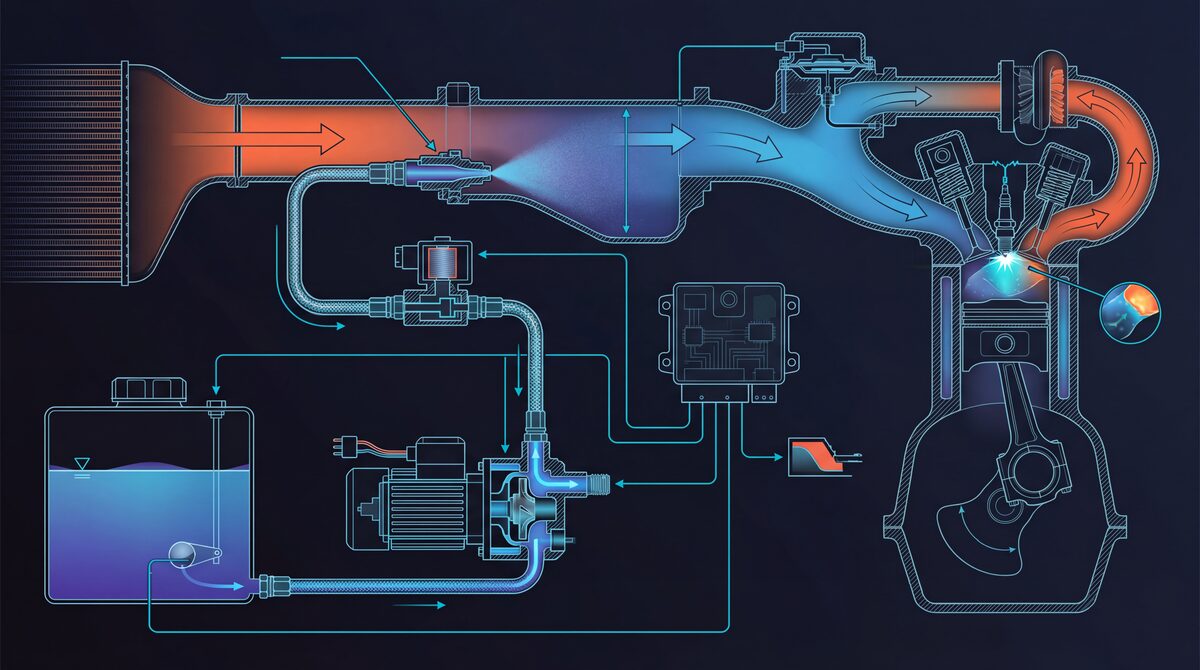
A turbo engine generates 30-50% more waste heat than the same engine naturally aspirated — the combustion of more fuel (made possible by forced induction) produces proportionally more heat that must be rejected through the cooling system. The stock radiator on a MK7 GTI is adequate for stock power and normal driving, but extended track sessions or high-power builds will push coolant temps above 230°F, at which point the ECU starts pulling timing (reducing power) to protect the engine.
Upgraded aluminum radiators (Mishimoto, CSF, Wagner Tuning) offer 30-50% more core volume with better fin density and thicker core depth. They're a direct bolt-in on most VW applications. Beyond the radiator, a lower-temp thermostat (opening at 170°F instead of the stock 190°F) keeps the system cycling coolant through the radiator sooner. Some builders add an auxiliary electric fan to ensure consistent airflow through the radiator at low vehicle speeds — critical for track cars that spend time in slow corners.
One cooling system detail unique to turbo cars: the turbo itself has a coolant circuit. When you shut the engine off after hard driving, the coolant stops circulating but the turbo's center section retains heat. Oil sitting in the bearing housing can "coke" — the heat carbonizes the oil into hard deposits that damage the bearings. VW's solution (documented in SSP436) is a coolant afterrun pump that circulates coolant through the turbo for several minutes after shutdown. On older cars without this feature, the builder's solution is a turbo timer that keeps the engine idling for 30-60 seconds after you turn off the ignition, or simply idling the car for a minute before shutting down.
Boost Gauges and Engine Monitoring
If you're running boost, you need to monitor what the engine is doing in real time. The essential gauges for any turbo VW build:
| Gauge | Priority | Why | Danger Zone |
|---|---|---|---|
| Oil Temperature | Essential | Most important indicator of engine stress | Above 260°F |
| Wideband AFR | Essential | Lean under boost = melted pistons | Above 14:1 under boost |
| Boost Pressure | Essential | Verify boost targets and detect leaks | Below target (leak) or overboost |
| Oil Pressure | Essential | Bearing health indicator | Below 25 PSI at operating temp/idle |
| EGT (Exhaust Gas Temp) | Recommended | Detects lean conditions before damage | Above 1600°F sustained |
| Fuel Pressure | Recommended | Catches fuel system limits under load | Dropping under WOT |
The wideband air-fuel ratio gauge deserves special attention. Under boost, the engine should run rich (11.5:1 to 12.5:1 AFR on gasoline) — the excess fuel absorbs heat and prevents detonation. A lean spike above 14:1 under full boost can melt a piston in seconds. A wideband O2 sensor and gauge (AEM, Innovate, PLX) placed in the downpipe gives you a real-time reading of combustion mixture quality. This is non-negotiable on any turbo build — it's a $200 investment that can save a $5,000 engine.
Data Logging for Turbo Diagnosis
Beyond real-time gauges, data logging captures every parameter the ECU measures at sample rates fast enough to catch transient events that gauges miss. On VW/Audi platforms:
VCDS (Ross-Tech): The gold standard for VW/Audi diagnostics. Reads every ECU parameter, logs at up to 20 Hz across multiple channels, and gives you the raw data to diagnose boost control issues, knock events, fuel system behavior, and timing corrections. Every serious VW tuner owns a VCDS cable.
OBD Eleven: Phone-app-based diagnostic tool with VW-specific features. Good for monitoring and basic logging, less capable than VCDS for deep multi-channel analysis. Excellent for on-the-go monitoring.
COBB Accessport: For cars running EQT/COBB tunes, the Accessport doubles as a gauge display and data logger. Built-in monitoring of critical parameters with customizable warnings.
Key parameters to log for turbo diagnosis: boost actual vs. target (is the wastegate controlling properly?), timing advance vs. requested (is the ECU pulling timing from knock?), knock retard (how much timing is being removed and on which cylinders?), LPFP and HPFP pressure (is the fuel system keeping up under load?), wideband lambda (is the mixture going lean?), and IAT — intake air temperature (is the intercooler doing its job?).
Do I need a catch can on an EA888 Gen3?
Yes — especially if your Gen3 doesn't have the dual-injection system (pre-2017 models without port injection). The Gen3's factory cyclone separator catches some oil mist, but it doesn't catch all of it. On a stock car, you'll see 50-100ml of oil in the catch can every 3,000-5,000 miles. On a tuned car with higher crankcase pressures, that number doubles. Dual-injection Gen3B models (2017+) are slightly less critical because the port injectors wash the intake valves periodically, but a catch can still prevents the oil mist from reaching the intake valves in the first place. At $150-$250 for a quality catch can from 034 or IE, it's cheap insurance against a $1,500 walnut blasting to clean carbon-caked valves.
Is water/methanol injection safe for daily driving?
The injection system itself is safe and reliable — AEM and Snow Performance kits have been on daily drivers for over a decade. The risk is human error: forgetting to refill the reservoir. If you run a pump-gas tune that expects water/methanol supplementation and the reservoir runs dry under boost, you can detonate the engine. The safe approach: run a conservative pump-gas base tune and use water/methanol as supplemental cooling — if it runs out, the engine still runs safely on the base tune, just with less power. Never tune TO the water/methanol limit. Always have a low-fluid sensor that triggers a boost cut.
What oil should I run in a turbo VW?
VW specifies 502.00 or 504.00/507.00 oil specs — most quality full-synthetic 5W-40 oils meet this. For stock to Stage 2 builds: Liqui Moly Leichtlauf, Castrol Edge, Motul 8100 X-cess in 5W-40 are all proven. For higher-power builds running track days: consider stepping up to a 5W-50 or even 10W-60 (Motul 300V, Driven DT40) for the additional high-temp film strength. Change intervals: 5,000 miles on a stock turbo car, 3,000-4,000 miles on a tuned car, and after every track day. Oil is cheap; engines are not.
THE VW/AUDI TURBO ENGINE FAMILY TREE
Fifty years of forced induction engineering, from the first supercharged G-Lader to today's 440 HP flash-tuned hatchbacks. Every engine in this family tree shares DNA — and understanding that lineage tells you what to expect from your build.
COLLAPSE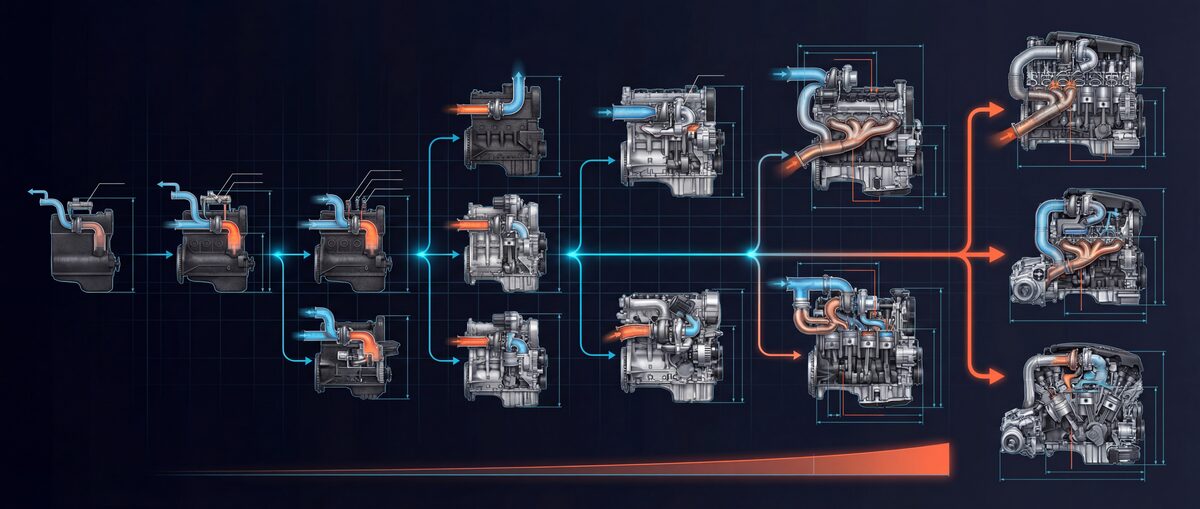
The Inline-4 Branch: EA827 → EA113 → EA888
The inline-4 is the backbone of VW performance. The story starts with the EA827 engine family in the early 1980s — the 8V (single cam, 8 valves) and 16V (dual cam, 16 valves) blocks that powered everything from the Rabbit to the Corrado. The 16V was naturally aspirated from the factory, but the community recognized the block's potential early. The G60 variant used a Roots-type supercharger (the G-Lader — a scroll-type compressor unique to VW), producing 160 HP in the Corrado G60. These weren't turbo engines, but they established VW's forced induction DNA and became some of the most popular turbo conversion platforms in the community.
EA113 1.8T (1996-2006): The Engine That Started It All
The EA113 1.8T 20-valve is arguably the most significant engine in VW tuning history. Produced from 1996 to 2006, it powered the MK4 GTI, GLI, New Beetle Turbo, Audi A4 1.8T, Audi TT, and dozens of SEAT and Skoda models worldwide. Key specifications: 1,781cc, cast iron block, aluminum 20-valve head (4 intake valves + 1 exhaust valve per cylinder), 9.5:1 compression ratio (AWP/BAM variants), and a KKK K03 or K04 turbocharger depending on the variant.
Engine codes and power levels ranged from the 150 HP AEB (early longitudinal A4) to the 225 HP BAM/AMU (TT 225, S3). The common platform codes: AEB, ATW, AWM, AWP, AWW (150-180 HP variants), and AMU, BAM, BEA (210-225 HP variants with the K04 turbo and larger intercooler).
The 1.8T's legend status in tuning comes from its overbuilt bottom end relative to factory power. The cast iron block, forged crankshaft, and 144mm connecting rod length gave the engine a strong foundation. With the stock K03 turbo, a tune yields 200-210 WHP. Swap to a K04 and tune, you're at 250-270 WHP. Replace the turbo entirely with a Precision 5858, BorgWarner EFR 7163, or a modern hybrid like the TTE420, and the factory bottom end holds 350-400 WHP before rod bolts become the limiting factor. Add forged internals and the EA113 block has been proven to 800+ WHP.
EA888: Four Generations of Refinement (2006-Present)
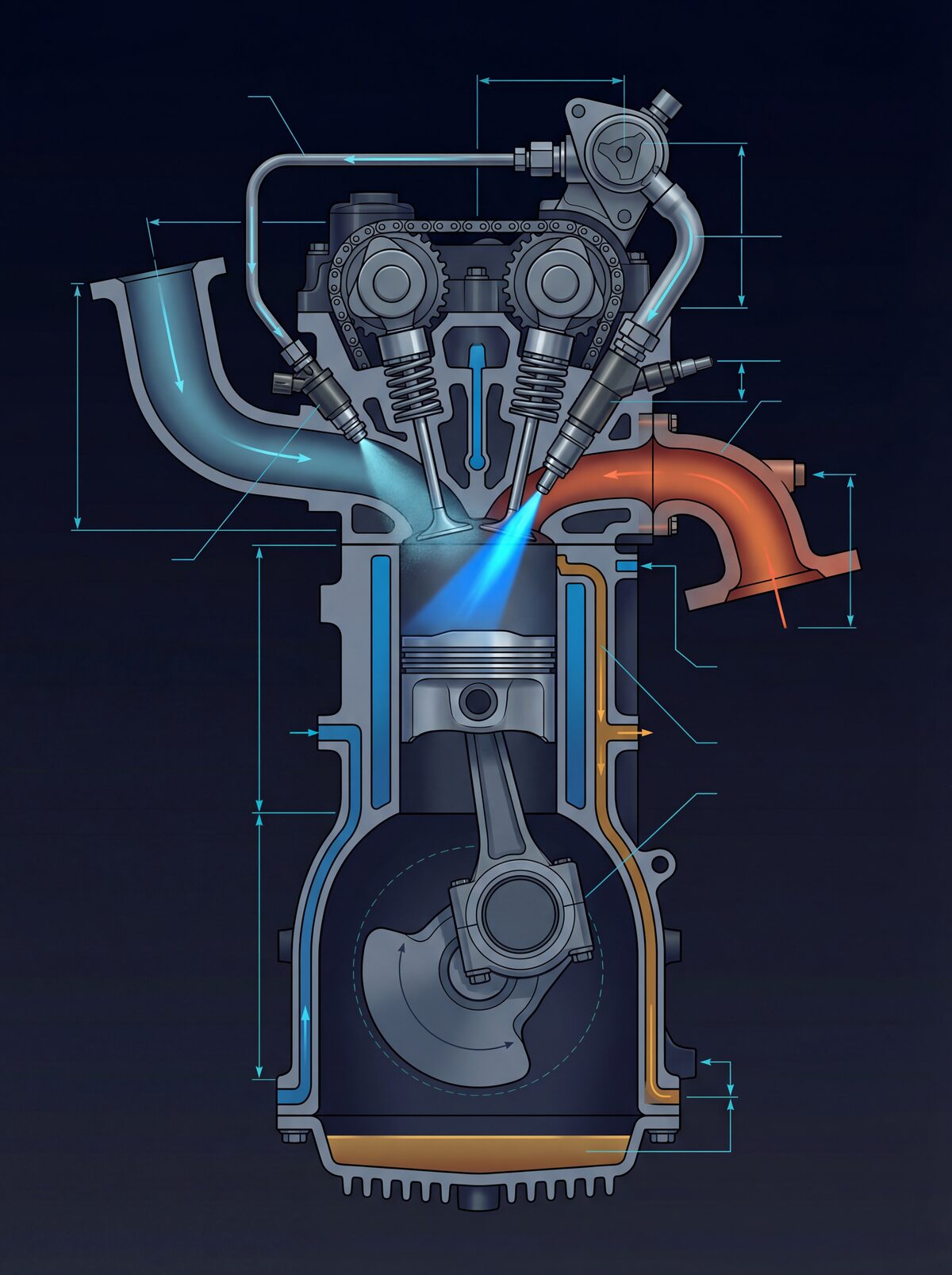
The EA888 replaced the EA113 in 2006 and has evolved through four generations, each more capable than the last. The key evolutionary steps:
Gen1 (2006-2008): 2.0L, aluminum block with cast iron sleeves, chain-driven DOHC, BorgWarner K03 turbo. Found in the MK5 GTI (BWA/BPY codes), Audi A3, Audi A4. Port injection. First VW 2.0T — 200 HP stock, ~280 WHP with K04 and tune. Known issues: cam follower wear (high-pressure fuel pump driven off the intake cam) and timing chain tensioner failure on early units.
Gen2 (2008-2012): Revised timing chain path, improved oil consumption, updated turbo variants. Found in MK6 GTI (CCTA/CBFA codes), Audi A4 B8 (CAEB). Still port injection. Resolved many Gen1 reliability issues. Same ~200 HP stock, similar tuning potential to Gen1 but with better base reliability.
Read the full EA888 Gen1/Gen2 Build Guide — TSI platform tuning, K04 upgrades, and budget power →
Gen3 (2013-2020): The breakthrough generation. Integrated exhaust manifold (IEM — exhaust manifold cast into the cylinder head), dual variable valve timing with AVS on the exhaust cam, switched from port injection to direct injection (early Gen3) and then to dual injection (Gen3B, ~2017+). IHI IS20 turbo on the GTI (220-230 HP), IS38 turbo on the Golf R / S3 (292-315 HP). The MQB platform enabled this engine across dozens of models. Tuning: Stage 1 on a GTI yields 300+ WHP. IS38 swap on a GTI yields 350+ WHP. Big turbo builds have reached 700+ WHP on stock block Gen3s with forged internals.
Gen4 / EA888 EVO (2020-present): Found in the MK8 GTI and Golf R. Revised turbo (IHI IS20 EVO on GTI, IS38 EVO on R), improved variable geometry on some variants, further refinement of dual injection, Miller cycle capability. The MK8 Golf R produces 315 HP stock and tunes to 400+ WHP on the stock turbo with an ECU flash. The platform is still new enough that the aftermarket is catching up — IS38 EVO hybrid turbos from TTE, Pure Turbos, and Vargas are already producing 500+ WHP results.
The VR6 Branch: Six Cylinders, Narrow Angle
The VR6 is VW's narrow-angle V6 — the two banks are set at just 15° (compared to 60° or 90° on conventional V6 engines), allowing the engine to fit in the same engine bay as an inline-4. The compact design uses a single cylinder head shared across both banks, which simplifies the valvetrain but limits breathing at high RPM.
12V VR6 (1991-1999, EA390): 2.8L (AAA code), 2.9L (ABV code in Corrado VR6). Cast iron block, 12 valves (2 per cylinder), 172-190 HP stock. The 12V VR6 turbo is one of the most iconic VW builds: the low-revving, torque-rich character of the VR6 combined with forced induction creates enormous mid-range thrust. Common turbo kits (Kinetic Motorsport, ATP) use a T3/T4 frame turbo with a custom tubular exhaust manifold. Stock internals handle 350-400 WHP; with forged rods and pistons, 600-800+ WHP is documented.
24V VR6 (1999-2006, EA390): 2.8L (BDF code) and 3.2L (BUB code in R32). 24 valves (4 per cylinder), variable intake manifold. Higher-revving than the 12V but paradoxically weaker internals — the 24V cast connecting rods fail earlier (~350 WHP) than the 12V rods. The 3.2L R32 variant is the king of VR6 turbo builds: 3.2L of displacement spooling a Precision 6266 or BorgWarner EFR 8374 makes monster mid-range torque with a civilized idle.
3.6L VR6 FSI (2005-present): Found in the CC, Passat, Atlas. Direct injection, 280 HP stock. Less popular for turbo builds due to the complexity of the FSI system and the weight of the vehicles it's installed in, but turbocharged 3.6L builds making 500+ WHP exist in the Phaeton and Touareg communities.
The 5-Cylinder Branch: EA855 2.5 TFSI
Audi's modern masterpiece. The EA855 2.5 TFSI has won the International Engine of the Year award nine times in a row (2010-2018) — no other engine has come close. Found in the RS3 and TTRS, it produces 394-401 HP in factory form and has a distinctive five-cylinder sound that Audi intentionally preserves through the exhaust tuning.
Gen1 (2009-2017): Cast iron block, 360-367 HP (8V RS3, 8J TTRS). Aftermarket potential is enormous — the iron block and forged crank handle massive power. With a turbo upgrade (Pure Turbos, TTE700) and supporting fuel system, 600-700+ WHP is achievable on stock internals. With forged rods and pistons, 1000+ WHP builds exist.
Gen2 / EVO (2017-present): Aluminum block with plasma-sprayed bore coating, 394-401 HP (8V.5 RS3, 8S TTRS). Lighter and more refined than Gen1, with improved turbo response. The aluminum block is more power-limited than the iron Gen1 — most builders cap at ~700 WHP on the stock block before opting for a sleeved block or reverting to the iron Gen1 block.
The V8 Branch: EA824 4.0 TFSI
For completeness: Audi's biturbo 4.0 V8 TFSI powers the RS6, RS7, S6, S7, and Lamborghini Urus. A hot-vee design (turbos mounted between the cylinder banks, inside the V), it produces 450-630 HP depending on the tune. Aftermarket tuning yields 700-900+ HP with relatively simple bolt-on modifications. This engine is beyond the scope of most VW enthusiasts but represents the pinnacle of VW Group forced induction engineering.
Platform Cross-Reference
| Platform | Chassis Codes | Engine Options | Years |
|---|---|---|---|
| PQ34 (MK4) | 1J | EA113 1.8T, VR6 12V/24V, 3.2 R32 | 1999-2005 |
| PQ35 (MK5) | 1K | EA113 2.0T FSI, EA888 Gen1, VR6 3.2 R32 | 2006-2009 |
| PQ46 (MK6) | 5K | EA888 Gen1/Gen2, 2.5 5-cyl (non-turbo) | 2010-2014 |
| MQB (MK7/7.5) | 5G/BQ | EA888 Gen3/Gen3B | 2015-2021 |
| MQB EVO (MK8) | CD | EA888 Gen4 (EVO) | 2022-present |
| Longitudinal B5-B9 | 8D/8E/8K/8W | EA113 1.8T, EA888 Gen1-4 | 1997-present |
| RS / Performance | 8V/8Y (RS3), 8J/8S (TTRS) | EA855 2.5 TFSI, EA824 4.0 V8 TFSI | 2009-present |
Which VW engine is best for a turbo build?
For the best balance of aftermarket support, tunability, and daily drivability: the EA888 Gen3. The IS20/IS38 turbo platform has the largest aftermarket support of any current VW engine, with bolt-on power paths from 300 WHP to 700+ WHP fully documented. For budget builds with maximum ceiling: the EA113 1.8T still can't be beaten — used engines are $500-$800, and the parts ecosystem is mature and affordable. For the "money is no object" approach: the EA855 2.5 TFSI makes the most power with the least modification, but parts and platform costs are significantly higher.
Can I turbo a naturally aspirated VW?
Absolutely — VR6 turbo conversions are one of the most popular builds in the VW community. A 12V VR6 or 3.2 R32 VR6 with an aftermarket turbo manifold, turbo, intercooler, fuel system, and standalone or custom ECU tune makes an incredible amount of torque. The 16V and 8V inline-4 engines can also be turbo'd, though they're better served as turbo conversion platforms (swap an already-turbo engine in) rather than retrofitting boost onto a non-turbo head. The key challenge in any turbo conversion is engine management — the factory ECU on a naturally aspirated engine doesn't know how to control boost, so you need either a standalone ECU (Haltech, MoTeC, Megasquirt) or a purpose-built conversion harness with a turbo-compatible ECU.
What's the difference between the Gen3 and Gen3B?
The Gen3B (introduced ~2017 on MK7.5 models) added port injection alongside the existing direct injection — "dual injection." This was VW's solution to two problems: carbon buildup on intake valves (port injection washes the valves, solving the DI-only problem) and cold-start emissions (port injection provides better mixture preparation in a cold engine). For tuners, dual injection also means more total fuel delivery capacity at high power — the port injectors supplement the direct injectors, which helps at 400+ WHP where the direct injection system alone may reach its limit. Mechanically, the rest of the Gen3B is identical to the Gen3.